Go check it out. It's funny, it's a reminder to keep memory alive and the dead presidents in their graves. Go check it out at:
The Pagan Science Monitor where truth never sleeps.
Thursday, December 28, 2006


Saturday, December 23, 2006
Let's All Face it: The War on Christmas makes the Holidays More Fun.
Back before the ideologues of the far-right started the hype about the "War on Christmas," there was so little to laugh about during the holiday season. The holidays were a time of panic about the expense of holiday shopping, hordes of sidewalk clogging tourists, and weight gain brought on by the cookie-baking mania and excessive partying. It was easy to feel resentful as a fully secular communist Jewish type when I was struggling through the crowds at Macy's to buy holiday gifts for my secular pinko-communist Jewish friends and family, or tripping through the pine-scented streets on my way home from work.
But the very propaganda of the "War on Christmas" has given me something to be part of during the holiday season. Instead of feeling excluded, I now belong! I belong to an army of disgruntled secularizers. It's kinda fun. In fact, the "war on Christmas" and the Christian right's excesses have brought all the cranky Jews and Pagans out of the closet to celebrate the holiday in all its non-Christian glory. I used to, in respect for other people's' religious beliefs, say "Merry Christmas" quite jovially to people far and wide. Not now. Commercial culture is even catching on and giving up the holly and sleighbells. In a hip, commercial decorating magazine, I read about how I might craft my very own Festivus party.
Everywhere you look, there are people cracking jokes about this ludicrous claim that began with a bunch of Fox news hacks and wacko evangelicals. Check out the Cafe Press items on sale. Look at the battlefield photos at Flickr, and Stephen Colbert has a whole season's worth of material.
However, the fact of its absurdity doesn't make the "War on Christmas" rhetoric a mere comedy vehicle. The war-on-Christmas story is a case of first time as farce, second time as tragedy. There's something truly pathetic about the fact that some people actually believe that such a war exists, and are willing to spend their money to fund the Christian soldiers of the solstice season. Last night on the train, I chatted briefly with a trainer from my gym, and before heading back to my earphones the 12/16/06 podcast of my favorite radio show, which right then, was doing an interview with the Reverend Barry Lynn of "Americans United for the Separation of Church and State" about his new book and what the Bible actually say, I said to this dark haired, small sized New Yorker, "Happy Holidays!" After all - he might be celebrating Channukka, and I was feeling friendly. "Merry CHRISTMAS!" he responded with vehemence and a fierce teeth-bearing grin.
OY!
Since when has saying "Merry Christmas" been a way to release your aggression at unsuspecting Jews? I thought that was an EASTER tradition, for Chrissake!
But the very propaganda of the "War on Christmas" has given me something to be part of during the holiday season. Instead of feeling excluded, I now belong! I belong to an army of disgruntled secularizers. It's kinda fun. In fact, the "war on Christmas" and the Christian right's excesses have brought all the cranky Jews and Pagans out of the closet to celebrate the holiday in all its non-Christian glory. I used to, in respect for other people's' religious beliefs, say "Merry Christmas" quite jovially to people far and wide. Not now. Commercial culture is even catching on and giving up the holly and sleighbells. In a hip, commercial decorating magazine, I read about how I might craft my very own Festivus party.
Everywhere you look, there are people cracking jokes about this ludicrous claim that began with a bunch of Fox news hacks and wacko evangelicals. Check out the Cafe Press items on sale. Look at the battlefield photos at Flickr, and Stephen Colbert has a whole season's worth of material.
However, the fact of its absurdity doesn't make the "War on Christmas" rhetoric a mere comedy vehicle. The war-on-Christmas story is a case of first time as farce, second time as tragedy. There's something truly pathetic about the fact that some people actually believe that such a war exists, and are willing to spend their money to fund the Christian soldiers of the solstice season. Last night on the train, I chatted briefly with a trainer from my gym, and before heading back to my earphones the 12/16/06 podcast of my favorite radio show, which right then, was doing an interview with the Reverend Barry Lynn of "Americans United for the Separation of Church and State" about his new book and what the Bible actually say, I said to this dark haired, small sized New Yorker, "Happy Holidays!" After all - he might be celebrating Channukka, and I was feeling friendly. "Merry CHRISTMAS!" he responded with vehemence and a fierce teeth-bearing grin.
OY!
Since when has saying "Merry Christmas" been a way to release your aggression at unsuspecting Jews? I thought that was an EASTER tradition, for Chrissake!
Thursday, December 21, 2006
Propaganda Machines Part Two
As promised, here's my second round of responses to right-wing Zionist talking points. One of these general points, applied in many situations is this one: The Arab nations want to "sweep Israel into the sea" and won't stop until they do. Thus, Israel must defend itself all the time.
3.According to Zionist history, in 1948, Israel had to defend itself against annihilation by the united force of all the Arab countries - whose primary motivation was anti-semitism. The Arab nations told the Palestinians to flee.
It is true that Israel was "born in the midst of a war with the Arabs of Palestine and the neighboring Arab states." (Shlaim, 28), but it is not clear that the motivation for this war was the hatred of Jews, nor is there any evidence to suggest that the Arab leadership issued orders to Palestinian Arabs to flee. From 1946-1947, David Ben Gurion united Zionist forces in Palestine into an army to pursue the formation of an Israeli state. In 1947, only one Arab leader supported such a Zionist state in Palestine, King Abdullah of Transjordan. The not-nearly as well organized Palestinian nationalists, a total of 4000 fighters united under the leader, al-Husayni, attacked Jewish targets in Palestine immediately following the UN decision to partition Palestine in the fall of 1947.(Pape, 65,77).
The response was as follows:
Ben Gurion's army pursued the objective of "Plan D" which was to attack Arab villages in Palestine (civilians) and thus remove Palestinians from Israel, beginning in April, 1948. In all, 350 villages were evacuated or abandoned, and 700,00 to 750,000 Palestinian refugees fled to the West Bank, to Gaza, and to Transjordan, Syria, and Lebanon. The very worst atrocities of the war (massacres of villagers) occurred in October and November of 1948. The goal was not simply to create a new state, but a state that was ethnically pure, or at least dominated by a Jewish population. Who then, are the people with a strong case of ethnic nationalism or "tribalism"?
Another part of the Zionist version of this history regards the combined invasion of Palestine by Egypt, Transjordan, Syria, Lebanon and Iraq, which is usually portrayed by Zionists as a group that numerically overwhelmed Israel. In fact, as Avi Shlaim points out, the Israeli forces outnumbered the combined Arab military force; Arab troops numbered 25,000, Israel troops went from 65,000 to 97,441. Moreover, the war aim of the Arab nations was not the single goal of "sweeping Israel into the sea" but a complicated mix of individual national objectives.
(on 1948, see Pape, Shlaim, and Morris).
4. Modern American zionism came to its full fruition following the 1967 war, when Israel expanded its territory significantly. This war has been portrayed in Zionist history as a heroic victory over hostile forces, and a necessity for Israel to defend itself from the hostile Arab world.
In 1967, Israel faced Palestinian attacks that were supported by the Syrian government. In response, Israel's Yitzhak Rabin threatened to "overthrow the Syrian regime" (Shlaim, 236). As Egypt, under Nasser, closed off the Straits of Tiran to Israeli shipping, massed troops on the Sinai border, and asked for the UN emergency forces to be removed from the Sinai, Israel responded with an attack now known as the "six day war" during which Israel was victorious and took the following territories: the Sinai peninsula, the West Bank, and the Golan Heights. This expansion of Israel's borders and its attempts to keep these territories remains the bone of contention today, and the proposal of many peace groups (including Jewish ones) is that Israel withdraw to its pre-1967 borders. In my next post, I will go into more detail on the history of the fate of territories occupied in 1967. In general, one could say that this occupation, and effort to make it permanent, and not anti-semitism, is the real source of continuing hostility to the state of Israel.
5. Another common event used to support the hypothesis of unrelenting Arab hostility is the "Yom Kippur War" of 1973
The surprise attack on Israel by Syria and Egypt in 1973 was a response to the continued Israeli occupation of Gaza and the West Bank. In fact, it was Moshe Dayan who told Time magazine in July of 1973, "There is no more Palestine. Finished" and his policy was to move settlers into the occupied territories "won" in 1967, including the Golan Heights, which were once part of Syria, and sought an Israel whose authority extended "from the Jordan to the Suez canal." The reason that Egypt and Syria attacked Israel in October of 1973 (The surprise "Yom Kippur war") was to put pressure on Israel to withdraw from the Occupied territories.
* For all of the above references, see Avi Shlaim, The Iron Wall: Israel and the Arab World.
and that's it for now.
3.According to Zionist history, in 1948, Israel had to defend itself against annihilation by the united force of all the Arab countries - whose primary motivation was anti-semitism. The Arab nations told the Palestinians to flee.
It is true that Israel was "born in the midst of a war with the Arabs of Palestine and the neighboring Arab states." (Shlaim, 28), but it is not clear that the motivation for this war was the hatred of Jews, nor is there any evidence to suggest that the Arab leadership issued orders to Palestinian Arabs to flee. From 1946-1947, David Ben Gurion united Zionist forces in Palestine into an army to pursue the formation of an Israeli state. In 1947, only one Arab leader supported such a Zionist state in Palestine, King Abdullah of Transjordan. The not-nearly as well organized Palestinian nationalists, a total of 4000 fighters united under the leader, al-Husayni, attacked Jewish targets in Palestine immediately following the UN decision to partition Palestine in the fall of 1947.(Pape, 65,77).
The response was as follows:
Ben Gurion's army pursued the objective of "Plan D" which was to attack Arab villages in Palestine (civilians) and thus remove Palestinians from Israel, beginning in April, 1948. In all, 350 villages were evacuated or abandoned, and 700,00 to 750,000 Palestinian refugees fled to the West Bank, to Gaza, and to Transjordan, Syria, and Lebanon. The very worst atrocities of the war (massacres of villagers) occurred in October and November of 1948. The goal was not simply to create a new state, but a state that was ethnically pure, or at least dominated by a Jewish population. Who then, are the people with a strong case of ethnic nationalism or "tribalism"?
Another part of the Zionist version of this history regards the combined invasion of Palestine by Egypt, Transjordan, Syria, Lebanon and Iraq, which is usually portrayed by Zionists as a group that numerically overwhelmed Israel. In fact, as Avi Shlaim points out, the Israeli forces outnumbered the combined Arab military force; Arab troops numbered 25,000, Israel troops went from 65,000 to 97,441. Moreover, the war aim of the Arab nations was not the single goal of "sweeping Israel into the sea" but a complicated mix of individual national objectives.
(on 1948, see Pape, Shlaim, and Morris).
4. Modern American zionism came to its full fruition following the 1967 war, when Israel expanded its territory significantly. This war has been portrayed in Zionist history as a heroic victory over hostile forces, and a necessity for Israel to defend itself from the hostile Arab world.
In 1967, Israel faced Palestinian attacks that were supported by the Syrian government. In response, Israel's Yitzhak Rabin threatened to "overthrow the Syrian regime" (Shlaim, 236). As Egypt, under Nasser, closed off the Straits of Tiran to Israeli shipping, massed troops on the Sinai border, and asked for the UN emergency forces to be removed from the Sinai, Israel responded with an attack now known as the "six day war" during which Israel was victorious and took the following territories: the Sinai peninsula, the West Bank, and the Golan Heights. This expansion of Israel's borders and its attempts to keep these territories remains the bone of contention today, and the proposal of many peace groups (including Jewish ones) is that Israel withdraw to its pre-1967 borders. In my next post, I will go into more detail on the history of the fate of territories occupied in 1967. In general, one could say that this occupation, and effort to make it permanent, and not anti-semitism, is the real source of continuing hostility to the state of Israel.
5. Another common event used to support the hypothesis of unrelenting Arab hostility is the "Yom Kippur War" of 1973
The surprise attack on Israel by Syria and Egypt in 1973 was a response to the continued Israeli occupation of Gaza and the West Bank. In fact, it was Moshe Dayan who told Time magazine in July of 1973, "There is no more Palestine. Finished" and his policy was to move settlers into the occupied territories "won" in 1967, including the Golan Heights, which were once part of Syria, and sought an Israel whose authority extended "from the Jordan to the Suez canal." The reason that Egypt and Syria attacked Israel in October of 1973 (The surprise "Yom Kippur war") was to put pressure on Israel to withdraw from the Occupied territories.
* For all of the above references, see Avi Shlaim, The Iron Wall: Israel and the Arab World.
and that's it for now.
Wednesday, December 13, 2006
Propaganda Machines
Once a week, my colleagues and I go out for happy hour, which is a testament to our general collegiality. Last week's happy hour, however, was marred slightly by the eruption of the Israel/Palestine question into our otherwise comradely chatter. I mentioned something about the occupation and my colleague, from across the table said," Occupation?!" as is if I had just asserted the reality of something that was in doubt. I'm not sure whether it's the insistance that I treat total propaganda as an "alternative view" or distortions and lies as "facts" or whether it's the pure racism involved in saying things like "Palestinians?" and "Occupation?" as if these were facts in question, but I was shocked and dismayed. The same colleague asked me yesterday if I knew about the group "CAMERA" which he described as a general mid-east media watch group with no political affiliation, out to give the "truth" on American news reporting from the Middle-East. "No," I said, "is it associated with AIPAC?"
"Oh, no" he responded.
The gist of his conversation was that he wanted to have a civil dialogue with me about the issues and offered to exchange information resources. This is the man who refused to read Tom Segev, on the basis that he was a "revisionist!" in the previous conversation. Finally, I had to tell him that I just didn't see the arguments he was making as an even a bit legitimate and that I couldn't have such a conversation with him on that basis at all. I said, "If you had a friend who loved Rush Limbaugh and insisted that he was telling the truth, and kept coming to you with things Rush had said, and asking you to take them seriously, wouldn't it drive you crazy?"
I could see that this hurt his feelings, and I felt bad about it, but on the other hand, he's coming to me with offensive, racist propaganda and asking me to accept it as a rational argument. If we were acquaintances in Mississippi in the 1960s, and he was talking about how inaccurate the Northern media was to depict Mississippi as a racist backwater, I'd have had to say the same thing.
Most of the time, I live in a bit of an alternative news "bubble" and unless I encounter students with very conservative views (this almost never happens where I teach) I don't often encounter right wing views, some of which seem like they are coming from another planet. In case you have the same experience...here's my report from the land of ultra-Zionist propaganda...part one.
The Right Wing Spin Machine on Israel/Palestine
1. "There are no Palestinians." This is the first departure point, and it's the one that Golda Meier made in her infamous statement, "There is no such thing as a Palestinian." Here is a web-site that promotes this point of view and a column from Ha'aretz that argues against it on this simple basis: no one gets to decide whether someone else's identity is valid or not.
Moreover...
* This justification for seizing other people's land is as specious as the justification used by the Puritans who came over to North America and seized Native American land on the basis that they a) didn't have the same concept of private property and farming as the Europeans and therefore couldn't make a legitimate ownership claim and b) weren't a nation in the European sense of the term.
I don't know what else to call it but racism when the basis for denying the existance of a people and their rights to stay where they are is that they are different from and therefore inferior to you. It doesn't matter whether the Palestinians have always called themselves Palestinians or not. The fact is, Israel was built on land that was inhabited by people, and the leaders of Israel expelled those people from their homes (about which, more later).
But let's see....what IS the basis of the Palestinian national identity?...It began in the 19th century, and you can find out more about it in the most serious scholarly history of it by Rashid Khalidi. For those who would claim that the Palestinians are not a "real" nation, it might be useful to think about the history of nationalism more generally. The "French" and "German" identities were also "made up" for political reasons. European historians generally agree with Benedict Anderson's description of the nation as an "imagined community" , not a biological reality.
2. The American media is biased against Israel and the Palestinians are manipulating the world media to hate Israel.
Yes, you heard it right. My colleague insisted that the liberal media couldn't be trusted in its reports from Israel. He went on to talk about CAMERA, which is not a neutral organization, which is affiliated with AIPAC, and which spends its time denying the murders of Palestinian children by the Israeli Defense forces. It does focusing on such cases as the image of Mohammed Al Duraduring the Al Aqsa intifada. In that case, the media first decided the photo was accurate, then later decided it was not. And with this one image, groups like CAMERA convince otherwise rational people that the entire record of crimes by the IDF is an elaborate Palestinian hoax. However, if you knew the big picture, you'd know this:
That's all I can manage for now, I'll do some more responses to ultra-right Zionist talking points later in the week.
"Oh, no" he responded.
The gist of his conversation was that he wanted to have a civil dialogue with me about the issues and offered to exchange information resources. This is the man who refused to read Tom Segev, on the basis that he was a "revisionist!" in the previous conversation. Finally, I had to tell him that I just didn't see the arguments he was making as an even a bit legitimate and that I couldn't have such a conversation with him on that basis at all. I said, "If you had a friend who loved Rush Limbaugh and insisted that he was telling the truth, and kept coming to you with things Rush had said, and asking you to take them seriously, wouldn't it drive you crazy?"
I could see that this hurt his feelings, and I felt bad about it, but on the other hand, he's coming to me with offensive, racist propaganda and asking me to accept it as a rational argument. If we were acquaintances in Mississippi in the 1960s, and he was talking about how inaccurate the Northern media was to depict Mississippi as a racist backwater, I'd have had to say the same thing.
Most of the time, I live in a bit of an alternative news "bubble" and unless I encounter students with very conservative views (this almost never happens where I teach) I don't often encounter right wing views, some of which seem like they are coming from another planet. In case you have the same experience...here's my report from the land of ultra-Zionist propaganda...part one.
The Right Wing Spin Machine on Israel/Palestine
1. "There are no Palestinians." This is the first departure point, and it's the one that Golda Meier made in her infamous statement, "There is no such thing as a Palestinian." Here is a web-site that promotes this point of view and a column from Ha'aretz that argues against it on this simple basis: no one gets to decide whether someone else's identity is valid or not.
Moreover...
* This justification for seizing other people's land is as specious as the justification used by the Puritans who came over to North America and seized Native American land on the basis that they a) didn't have the same concept of private property and farming as the Europeans and therefore couldn't make a legitimate ownership claim and b) weren't a nation in the European sense of the term.
I don't know what else to call it but racism when the basis for denying the existance of a people and their rights to stay where they are is that they are different from and therefore inferior to you. It doesn't matter whether the Palestinians have always called themselves Palestinians or not. The fact is, Israel was built on land that was inhabited by people, and the leaders of Israel expelled those people from their homes (about which, more later).
But let's see....what IS the basis of the Palestinian national identity?...It began in the 19th century, and you can find out more about it in the most serious scholarly history of it by Rashid Khalidi. For those who would claim that the Palestinians are not a "real" nation, it might be useful to think about the history of nationalism more generally. The "French" and "German" identities were also "made up" for political reasons. European historians generally agree with Benedict Anderson's description of the nation as an "imagined community" , not a biological reality.
2. The American media is biased against Israel and the Palestinians are manipulating the world media to hate Israel.
Yes, you heard it right. My colleague insisted that the liberal media couldn't be trusted in its reports from Israel. He went on to talk about CAMERA, which is not a neutral organization, which is affiliated with AIPAC, and which spends its time denying the murders of Palestinian children by the Israeli Defense forces. It does focusing on such cases as the image of Mohammed Al Duraduring the Al Aqsa intifada. In that case, the media first decided the photo was accurate, then later decided it was not. And with this one image, groups like CAMERA convince otherwise rational people that the entire record of crimes by the IDF is an elaborate Palestinian hoax. However, if you knew the big picture, you'd know this:
According to B’Tselem, the Israeli Information Center for Human Rights in the Occupied Territories, Israeli security forces killed 2,038 Palestinians between 29 September 2000 and 11 May 2003. Of these, 366 (18%) were minors under the age of 18. Indeed, by the end of the second day of the al-Aqsa Intifada, the day on which Mohammed al-Dura died, 15 Palestinians had already been killed. Of these, four (27%) were minors. Besides Mohammad al-Dura, whose death was so graphically captured on video, B’Tselem reports these otherwise-invisible child casualties:
· Khaled 'Adli al-Baziyan, age 15, from Nablus, killed by Israeli security forces live gunfire to the head in Nablus/The West Bank
· Nizar Mahmud 'Abd al-'Ayedeh, age 16, from Deir 'Ammar/Ramallah, killed by Israeli security forces gunfire to the chest in Ramallah/The West Bank
· 'Iyyad Ahmad al-Khashashi, age 16, from Nablus, killed by Israeli security forces live gunfire in Nablus/The West Bank
The day after Mohammad al-Dura died, four more minors—including another 12-year-old, Samer Samir Sudki Tabanjeh—were killed by Israeli security forces.
(By comparison, B’Tselem reports that between 29 September 2000 and 11 May 2003 Palestinians killed 483 Israeli civilians and 216 Israeli security personnel, or 699 total. Of these, 92 or 13% were minors. By the end of the second day of the intifada one Israeli soldier but no Israeli civilians, and therefore no Israeli minors, had been killed. Further information is available at www.btselem.org.)
That's all I can manage for now, I'll do some more responses to ultra-right Zionist talking points later in the week.
Sunday, December 10, 2006
All New Game in Town
So, the president has said he rejects the "Iraq study group solution." Condoleeza Rice says she doesn't want to make nice with Syria and Iran. According to the NY Daily News, "The White House is totally constipated," a former aide complained. "There's not enough adult leadership, and the 30-year-olds still think it's 2000 and they're riding high." SO. What IS Bush/Cheney's "secret plan" to win the war? I welcome serious attempts and satire:
Wednesday, December 06, 2006
More Global Warming News
I was just checking my email for the hundreth time today, wondering what I was looking for. It must have been this link to a story from Reuters at "Truth Out" which announces that the Alps are currently undergoing the warmest winter in 1300 years.
It's not reassuring then that the proposed budget (which I have hanging on my office wall) for 2007 included cuts in environmental and energy programs. Since the last congress could not come to agreement on the 2007 budget I hope this means that the new one will be able to monkey around with it a little.
This winter should fuel (sorry, I couldn't resist) the movement to take action to slow down global warming, but the media's portrayal of the issue is making it sound as if any effort to control carbon emissions is some kind of inexcusable government interference in our "way of life." Meanwhile, the same crowd finds the Patriot Act and the rest just fine. ahh...my anxiety is bubbling. For an interesting piece on the latest see Think Progress.
It's not reassuring then that the proposed budget (which I have hanging on my office wall) for 2007 included cuts in environmental and energy programs. Since the last congress could not come to agreement on the 2007 budget I hope this means that the new one will be able to monkey around with it a little.
This winter should fuel (sorry, I couldn't resist) the movement to take action to slow down global warming, but the media's portrayal of the issue is making it sound as if any effort to control carbon emissions is some kind of inexcusable government interference in our "way of life." Meanwhile, the same crowd finds the Patriot Act and the rest just fine. ahh...my anxiety is bubbling. For an interesting piece on the latest see Think Progress.
Friday, December 01, 2006
Freaky Friday
Last night, I was walking through the West Village with my Aunt, dodging the partying NYU students who appeared to be on a premature Spring break. As we shuffled along with jackets in hand, I wondered whether this was really the end of winter as we know it. For this reason, I was glad to see this article in New York magazine that attempts to explain the weird weather.
The current warm spell that we're experiencing can be attributed to El Nino, but the larger context for that and other changes is global warming. According to the article,
I remember back in the warm winter of '97 that people said "it's El Nino, not global warming," but climatologists argue that it's not an "either/or" explanation. We'll continue to have more el ninos because of global warming.
Has anyone else noticed how people keep saying hopefully, "it's really going to cool down this weekend!" and then if you look at the forecasts, it says it will be in the high forties? Sheesh, it's December and I still have time to plant hollyhocks for next year. I was already delaying Fall bulb planting by a month to fit the real temperatures, and it looks like I'm not alone.
The current warm spell that we're experiencing can be attributed to El Nino, but the larger context for that and other changes is global warming. According to the article,
The computer models reviewed in the “Metropolitan East Coast Climate Assessment”—a 50-year prediction of New York’s changing climate, developed by nasa and Columbia University—suggest that the city will continue to heat up by as much as one degree by 2010, two degrees by 2020, and accelerate on a gentle curve until we reach as much as nine degrees warmer than now in 2100.
I remember back in the warm winter of '97 that people said "it's El Nino, not global warming," but climatologists argue that it's not an "either/or" explanation. We'll continue to have more el ninos because of global warming.
Has anyone else noticed how people keep saying hopefully, "it's really going to cool down this weekend!" and then if you look at the forecasts, it says it will be in the high forties? Sheesh, it's December and I still have time to plant hollyhocks for next year. I was already delaying Fall bulb planting by a month to fit the real temperatures, and it looks like I'm not alone.
Wednesday, November 29, 2006
National Resistance Movement or Civil War?
The other day, someone from Left Spot, which is, as far as I can tell, the blog of an old friend of mine who's now part of the Freedom Road Socialist Organization (FRSO), argued in a comment on my last post that I shouldn't refer to what's occuring in Iraq right now as a civil war. There are others in the revolutionary socialist left who have made similar arguments, most notably ,the International Socialist Organization (ISO) which, at least the last time I checked, had been arguing that the anti-war movement should support the Iraqi resistance.
Since I'm no longer a member of any sectarian left group, I haven't been involved in such a debate for a while, but I can see the relevance of this particular seemingly far-fetched position denying that there is a civil war going on in Iraq to the US anti-war movement, and had an email exchange about it two years ago with Rahul Mahajan of Empire Notes, who certainly doesn't see the current insurgents as a group that Americans should laud as a national liberation movement. He also argues that the situation in Iraq is now a civil war, or at least close to it, commentng that: "it’s already at somewhere not too far from the level in the Lebanese or Bosnian civil wars."
I haven't seen many articles that characterize the Iraqi resistance as a "heroic national liberation movement," though there is this one which seems to be based more in the theory of resistance than the actual on-the-ground happenings in Iraq. England's Respect party also defines the current action in Iraq as such a movement.
Loretta Napoleoni, whose book may be the most detailed look into the Iraqi insurgency, describes the resistance as follows:
Based on what I've read from people who take the "heroic national liberation movement" line on describing the mass killings of civilians going on in Iraq, it seems like the resistance to calling it a "civil war" has to do with what this means for whether Americans support immediate withdrawl or not, and the relationship of anti-Shi'ite violence to the relationship of the Shi'ites and the US. However, with the current situation, I don't think it's safe to say that the US is simply pro-Shi'ite anymore. Also, the assumption seems to be that if we call it a "civil war" it means we have to stay there. I don't like this particular tendency in the debate, because it seems to me to deny an apparent reality in order to justify a political position, instead of basing a strategy on what's actually happening. Second, I haven't seen anyone who's in any real contact with people in Iraq take this position, which makes me think it's ill-informed. There are plenty of people who say that the Iraqis are in a civil war - and that the civil war is being provoked by the US occupation, although it would probably not end with the occupation's departure. Patrick Cockburn, whose work I linked in the last post, and more recently, Nir Rosen on Democracy Now, and Al Jazeera are perfectly capable of taking a "troops out" now position while also describing the violence in Iraq as a civil war.
But, perhaps LS and others have more to say to explain their position?
Since I'm no longer a member of any sectarian left group, I haven't been involved in such a debate for a while, but I can see the relevance of this particular seemingly far-fetched position denying that there is a civil war going on in Iraq to the US anti-war movement, and had an email exchange about it two years ago with Rahul Mahajan of Empire Notes, who certainly doesn't see the current insurgents as a group that Americans should laud as a national liberation movement. He also argues that the situation in Iraq is now a civil war, or at least close to it, commentng that: "it’s already at somewhere not too far from the level in the Lebanese or Bosnian civil wars."
I haven't seen many articles that characterize the Iraqi resistance as a "heroic national liberation movement," though there is this one which seems to be based more in the theory of resistance than the actual on-the-ground happenings in Iraq. England's Respect party also defines the current action in Iraq as such a movement.
Loretta Napoleoni, whose book may be the most detailed look into the Iraqi insurgency, describes the resistance as follows:
Beyond the myth of Zarquawi there is a much more frightening reality made up of complex forces: independent Iraqi jihadist groups that gravitate toward Al Qaeda in Iraq, Islamo-nationalist and Baath party resistance fighters opposing coalition forces; ethnic conflict among the Sunni, Shi'ites and Kurds; fully armed and active ethnic and religious militias' and an endless stream of foreign suicide bombers. This is a scenario that may well haunt Americans for decades. It is the true nature of the insurgency.
Based on what I've read from people who take the "heroic national liberation movement" line on describing the mass killings of civilians going on in Iraq, it seems like the resistance to calling it a "civil war" has to do with what this means for whether Americans support immediate withdrawl or not, and the relationship of anti-Shi'ite violence to the relationship of the Shi'ites and the US. However, with the current situation, I don't think it's safe to say that the US is simply pro-Shi'ite anymore. Also, the assumption seems to be that if we call it a "civil war" it means we have to stay there. I don't like this particular tendency in the debate, because it seems to me to deny an apparent reality in order to justify a political position, instead of basing a strategy on what's actually happening. Second, I haven't seen anyone who's in any real contact with people in Iraq take this position, which makes me think it's ill-informed. There are plenty of people who say that the Iraqis are in a civil war - and that the civil war is being provoked by the US occupation, although it would probably not end with the occupation's departure. Patrick Cockburn, whose work I linked in the last post, and more recently, Nir Rosen on Democracy Now, and Al Jazeera are perfectly capable of taking a "troops out" now position while also describing the violence in Iraq as a civil war.
But, perhaps LS and others have more to say to explain their position?
Saturday, November 25, 2006
Happy Thanksgiving, Happy Civil War
It's distressing to read that in the midst of annual consumer hoopla over "Black Friday" that government officials in Iraq "do not believe that this is a civil war."
Juan Cole's blog has a collection of the ongoing news reports about the continuing Shiite reprisals for Sunni violence, including a translation of Muqtada Al Sadr's address demanding that Sunnis not kill Shia, not join Al Quaeda, and his continuing call for the US troops to set a time-table for withdrawl from Iraq.
Cole says...
If the Iraq war is our generation's Vietnam, this latest upsurge in violence may be this war's Tet Offensive - inasmuch as it reveals the true failure of the US occupation to maintain peace or stability. Patrick Cockburn was reporting three weeks ago in the London Independent that Iraq is not "on the way to civil war" but that the entire country is disintegrating and is actively in the midst of a civil war and has been for some time. In his article "Baghdad Under Seige"
he sums it up:
In the midst of this ongoing disaster, it appears that the ever-predictable Fox news was covering something else. Now, Cheney is in Saudi Arabia, while Bush heads off to talk to Al Maliki in Jordan, and Tom Hayden, in articles at Huffington Post, says that he has documents proving that the Bush administration has been secretly negotiating with the Sunni armed resistance. None of us would put it past them to rewind the tape in Iraq to the pre-2003 war solution: ensure stability and keep the Shia out of power by ushering an appropriate Sunni "strongman" into place in the region. Alexander Cockburn puts it this way, "If some Sunni substitute for Saddam stepped up to the plate the US would welcome him and propel him into power..." However, with the carnage and dissaray we see now, "it is too late for such a course."
Who can say what the next step will be. Cockburn continues:
Here is my prediction. Since Cheney is in Saudi Arabia attempting to get the US's "friends" the Saudi Wahabbis to "calm" the Iraqi Sunnis, we are going to try to create some kind of "multi-national" regional force involving the Saudis to attempt to impose order on Iraq and to keep Iran in check. The US will try to sell this group the way they sold the Taliban to us back in 1995....I just wonder where it will lead - especially given parallel efforts on the Iranian side. If a civil war isn't enough to bring on the "endtimes" maybe a regional one will be.
Juan Cole's blog has a collection of the ongoing news reports about the continuing Shiite reprisals for Sunni violence, including a translation of Muqtada Al Sadr's address demanding that Sunnis not kill Shia, not join Al Quaeda, and his continuing call for the US troops to set a time-table for withdrawl from Iraq.
Cole says...
Members of Muqtada's bloc in Parliament, such as Faleh Hasan Shanshal, have threatened to pull out of the al-Maliki government if the prime minister follows through with his plans to meet US President George W. Bush in Amman on Wednesday. Bush's spokesman say that the meeting would be held nevertheless. Why US news services feel the need to report the rest of what the spokesman said, especially fairly high up in the article, is beyond me. Nonsense such as that Iraq is not in a civil war or that the violence will be "high on the agenda" at the Amman meeting is only worthy of being ignored or derided. If Bush was able to do anything about the violence in Iraq, he wouldn't have to meet al-Maliki in the neighboring country of . . . Jordan. I think the Pentagon has concluded that Baghdad is just too dangerous and unpredictable to allow Bush to go there anymore.
If the Iraq war is our generation's Vietnam, this latest upsurge in violence may be this war's Tet Offensive - inasmuch as it reveals the true failure of the US occupation to maintain peace or stability. Patrick Cockburn was reporting three weeks ago in the London Independent that Iraq is not "on the way to civil war" but that the entire country is disintegrating and is actively in the midst of a civil war and has been for some time. In his article "Baghdad Under Seige"
he sums it up:
The scale of killing is already as bad as Bosnia at the height of the Balkans conflict. An apocalyptic scenario could well emerge - with slaughter on a massive scale. As America prepares its exit strategy, the fear in Iraq is of a genocidal conflict between the Sunni minority and the Shias in which an entire society implodes. Individual atrocities often obscure the bigger picture where:
* upwards of 1,000 Iraqis are dying violently every week;
* Shia fighters have taken over much of Baghdad; the Sunni encircle the capital;
* the Iraqi Red Crescent says 1.5 million people have fled their homes within the country;
* the Shia and Sunni militias control Iraq, not the enfeebled army or police.
In the midst of this ongoing disaster, it appears that the ever-predictable Fox news was covering something else. Now, Cheney is in Saudi Arabia, while Bush heads off to talk to Al Maliki in Jordan, and Tom Hayden, in articles at Huffington Post, says that he has documents proving that the Bush administration has been secretly negotiating with the Sunni armed resistance. None of us would put it past them to rewind the tape in Iraq to the pre-2003 war solution: ensure stability and keep the Shia out of power by ushering an appropriate Sunni "strongman" into place in the region. Alexander Cockburn puts it this way, "If some Sunni substitute for Saddam stepped up to the plate the US would welcome him and propel him into power..." However, with the carnage and dissaray we see now, "it is too late for such a course."
Who can say what the next step will be. Cockburn continues:
As Henry Kissinger said earlier this week, the war is lost. This is the man who -- if we are to believe Bob Woodward's latest narrative -- has been advising Bush and Cheney that there could be no more Vietnams, that the war in Iraq could not be lost without humiliating consequences for America's status as the number # 1 bully on the block. When Kissinger says a war is lost, you can reckon that it is.
Here is my prediction. Since Cheney is in Saudi Arabia attempting to get the US's "friends" the Saudi Wahabbis to "calm" the Iraqi Sunnis, we are going to try to create some kind of "multi-national" regional force involving the Saudis to attempt to impose order on Iraq and to keep Iran in check. The US will try to sell this group the way they sold the Taliban to us back in 1995....I just wonder where it will lead - especially given parallel efforts on the Iranian side. If a civil war isn't enough to bring on the "endtimes" maybe a regional one will be.
Thursday, November 16, 2006
Trying Vietnam All Over Again
If at first you don't succeed "try, try again." This can be a nice motto for many endeavors in life, but it shouldn't be for wars, no matter what John McCainsays.
When Kerry ran for prez. in 2004 he arguedthat he would send more troops, that he wouldn't try to win "war on the cheap," and since then, others of those critical of the Bush administration's handling of the war have made similar arguments that the problem with the war is that we haven't sent in enough troops to win the war. Many in the general population, even those against the war, will say the same thing. Just last night I was talking to a bartender in Windsor Terrace (hardly a lefty neighborhood) who was as critical of US foreign policy as anyone I've met in recent years. He was going on about the US's support of the Saudis and the Shah, and talked about his hatred for the whole Bush family. And he asked me, "in one or two sentences, how do we fix the problem in Iraq?"
My answer began, "first, pull the troops out." He objected strongly and said, "the root of this whole thing is the Sunni Shia conflict," and suggested that if the troops were to come out now, Iraq would be overtaken in chaos and civil war.
I almost replied that the "send in more troops" solution hadn't' worked in Vietnam and it wouldn't work here either, until I remembered that there's a whole popular school of thoughtthat the reason that we lost the war in Vietnam was that we fought it with "one hand tied behind our back."
My students always say on the first few days of class that they think history is important because if you don't know about the past, you'll be doomed to repeat past mistakes, but I beg to differ. It's not complete ignorance about the past, but the knowledge of useful mythologies about the past that allows people to confidently reapply wrong-headed strategies in the present day.
We need people like George McGovern, with all his incapacity to win elections, to remind us that "more troops" didn't work then, and it won't work now. The US occupation is the reason for the insurgency, so if the troops are pulled out, much of the energy and support for the insurgency will disappear, making it much easier for the Iraqis to quell any remaining "sectarian violence."
If your jury's out on what the insurgency is, and what is driving it, I recommend the following reading: Christian Parenti's The Freedom and Loretta Napoleoni's Insurgent Iraq.
When Kerry ran for prez. in 2004 he arguedthat he would send more troops, that he wouldn't try to win "war on the cheap," and since then, others of those critical of the Bush administration's handling of the war have made similar arguments that the problem with the war is that we haven't sent in enough troops to win the war. Many in the general population, even those against the war, will say the same thing. Just last night I was talking to a bartender in Windsor Terrace (hardly a lefty neighborhood) who was as critical of US foreign policy as anyone I've met in recent years. He was going on about the US's support of the Saudis and the Shah, and talked about his hatred for the whole Bush family. And he asked me, "in one or two sentences, how do we fix the problem in Iraq?"
My answer began, "first, pull the troops out." He objected strongly and said, "the root of this whole thing is the Sunni Shia conflict," and suggested that if the troops were to come out now, Iraq would be overtaken in chaos and civil war.
I almost replied that the "send in more troops" solution hadn't' worked in Vietnam and it wouldn't work here either, until I remembered that there's a whole popular school of thoughtthat the reason that we lost the war in Vietnam was that we fought it with "one hand tied behind our back."
My students always say on the first few days of class that they think history is important because if you don't know about the past, you'll be doomed to repeat past mistakes, but I beg to differ. It's not complete ignorance about the past, but the knowledge of useful mythologies about the past that allows people to confidently reapply wrong-headed strategies in the present day.
We need people like George McGovern, with all his incapacity to win elections, to remind us that "more troops" didn't work then, and it won't work now. The US occupation is the reason for the insurgency, so if the troops are pulled out, much of the energy and support for the insurgency will disappear, making it much easier for the Iraqis to quell any remaining "sectarian violence."
If your jury's out on what the insurgency is, and what is driving it, I recommend the following reading: Christian Parenti's The Freedom and Loretta Napoleoni's Insurgent Iraq.
Saturday, November 04, 2006
The Scandalous Exclusion of Howie Hawkins
There are few better examples of the corporate freeze-out of the public than the Senate race in New York. The candidates are: Hillary Clinton (D), John Spencer (R) and though you wouldn't know it, Howie Hawkins (G). Hawkins is running on an anti-war position, was endorsed by anti-war candidate Jonathan Tasini as well as by Cindy Sheehan, but because Hillary Clinton refused to debate him, and because the mainstream anti-war voices have not covered or endorsed his campaign, despite his meeting all the League of Women Voters' standards for legitimate candidacy(including fundraising and poll numbers), he has received no media attention. In the progressive blogosphere, as represented by the Dailykos, his name appears only once in a diary.
Those who listen to Pacifica radio's "Democracy Now" probably know that the League of Women Voters have withdrawn their approval not only from the debates between Clinton and Spencer, but from a number of debates because of Democratic candidates refusal to appear in debates with third party anti-war candidates.
After reading just a few stories based on "man on the street" feeling about the voters who may turn out again this time around because of their disgust about the war, I'm sure that if some of those New Yorkers knew Hawkins was running, or what he stood for, they would vote for him rather than Hillary C.
New York Newsday puts it like this :
But what message are voters who vote for Hillary Clinton sending about Iraq?
Maybe it's to "stay the course" after all, and it doesn't send a good message to the dems about 2008. I think she should be punished at the polls for the greater good, and here's why:
In 2002, Hillary Clinton, made this speech explaining why she would support Bush's resolution to use force in Iraq:
In late 2005, Clinton was critical of the president and presented herself, as well as other members of congress, as being "duped" into voting for war based on faulty intelligence - despite the fact that anyone with a brain was already saying in 2002 that the Bushies were not to be trusted. However, her argument was still for war:
"It is time for the President to stop serving up platitudes and present us with a plan for finishing this war with success and honor," she said,
In her other, more recent positions, Clinton continues to triangulate. Like John Kerry, who blew the 2004 election because he refused to take an anti-war position, she is critical of the management of the war "on the cheap," but doesn't call for withdrawl of troops. In fact, the Democratic plan for Phased redeployment that Clinton and other milque-toast dems support does not include a meaningful time-table for withdrawl, and because it suggests little more than the "Vietnamization" strategy that Bush seems already to have put forth, does not inspire confidence in the Dems' will to truly "change course" in Iraq.
As Norm Solomon reminds us:
But, say, people, at least Hillary Clinton will be better on domestic issues than Bush. I wonder how true that really is. Medea Benjamin, who went with the "Anybody But Bush" line and cast her support to Kerry in 2004, describes how Clinton thwarted efforts of anti-war activists to be heard at a "take back America" conference, at which CODEPINK was a registered participant organization with a table and an pre-conference agreement with the organizers. Despite this, they were turned away at the door.
If anything, the complete blackout of anti-war candidates and voices from this year's political races is even worse than it was in 2004, and that may just be because the public's position has shifted so dramatically against the war that the Democrats are running scared, not just from the Republican machine, but from the true wishes of the majority of Americans.
Those who listen to Pacifica radio's "Democracy Now" probably know that the League of Women Voters have withdrawn their approval not only from the debates between Clinton and Spencer, but from a number of debates because of Democratic candidates refusal to appear in debates with third party anti-war candidates.
After reading just a few stories based on "man on the street" feeling about the voters who may turn out again this time around because of their disgust about the war, I'm sure that if some of those New Yorkers knew Hawkins was running, or what he stood for, they would vote for him rather than Hillary C.
New York Newsday puts it like this :
People don't turn out only for cliffhangers," said Miringoff. "They show up when they have something to say or to send a message. For Democrats in New York, it's send a message to George Bush about Iraq and they'll use the congressional races to do that.
But what message are voters who vote for Hillary Clinton sending about Iraq?
Maybe it's to "stay the course" after all, and it doesn't send a good message to the dems about 2008. I think she should be punished at the polls for the greater good, and here's why:
In 2002, Hillary Clinton, made this speech explaining why she would support Bush's resolution to use force in Iraq:
I will take the President at his word that he will try hard to pass a UN resolution and will seek to avoid war, if at all possible. Because bipartisan support for this resolution makes success in the United Nations more likely, and therefore, war less likely, and because a good faith effort by the United States, even if it fails, will bring more allies and legitimacy to our cause, I have concluded, after careful and serious consideration, that a vote for the resolution best serves the security of our nation. If we were to defeat this resolution or pass it with only a few Democrats, I am concerned that those who want to pretend this problem will go way with delay will oppose any UN resolution calling for unrestricted inspections. This is a very difficult vote. This is probably the hardest decision I have ever had to make -- any vote that may lead to war should be hard -- but I cast it with conviction.
In late 2005, Clinton was critical of the president and presented herself, as well as other members of congress, as being "duped" into voting for war based on faulty intelligence - despite the fact that anyone with a brain was already saying in 2002 that the Bushies were not to be trusted. However, her argument was still for war:
"It is time for the President to stop serving up platitudes and present us with a plan for finishing this war with success and honor," she said,
– not a rigid timetable that terrorists can exploit, but a public plan for winning and concluding the war. And it is past time for the President, Vice President, or anyone else associated with them to stop impugning the patriotism of their critics.
In her other, more recent positions, Clinton continues to triangulate. Like John Kerry, who blew the 2004 election because he refused to take an anti-war position, she is critical of the management of the war "on the cheap," but doesn't call for withdrawl of troops. In fact, the Democratic plan for Phased redeployment that Clinton and other milque-toast dems support does not include a meaningful time-table for withdrawl, and because it suggests little more than the "Vietnamization" strategy that Bush seems already to have put forth, does not inspire confidence in the Dems' will to truly "change course" in Iraq.
As Norm Solomon reminds us:
Tactical critiques of war management are standard ways that politicians keep wars going while they give superficial nods to voters' frustration and anger. Those kinds of rhetorical maneuvers went on for the last several years of the war in Vietnam, while the death toll mounted at the same time that polls showed most Americans had turned against the war. These days, Hillary Clinton must be very appreciative that MoveOn is helping her to finesse the war in Iraq while she continues to support it.
But, say, people, at least Hillary Clinton will be better on domestic issues than Bush. I wonder how true that really is. Medea Benjamin, who went with the "Anybody But Bush" line and cast her support to Kerry in 2004, describes how Clinton thwarted efforts of anti-war activists to be heard at a "take back America" conference, at which CODEPINK was a registered participant organization with a table and an pre-conference agreement with the organizers. Despite this, they were turned away at the door.
A few CODEPINK women did manage to get inside the breakfast, however, as they were legitimate ticket holders. Once inside, the CODEPINK women soon realized that they had been deceived about the second part of the agreement: They would not be allowed to ask the first question, or any question, because Hillary Clinton would not be fielding questions from the audience. “We were really upset that we had been lied to by Take Back America, and that there would be no space at this ‘progressive conference’ to have a dialogue with Hillary Clinton about the most critical issue of our time—the war in Iraq,” said Katie Heald, DC coordinator for CODEPINK. “We got up on our chairs holding up our hands with the peace sign, and were pulled down from the chairs. We tried to take out our banner that said “Listen Hillary: Stop Supporting the War” and it was grabbed from us. And when Hillary started talking about her Iraq strategy, criticizing Bush but not posing a solution, we shouted ‘What are YOU going to do to get us out of Iraq,’ but she ignored us.”
If anything, the complete blackout of anti-war candidates and voices from this year's political races is even worse than it was in 2004, and that may just be because the public's position has shifted so dramatically against the war that the Democrats are running scared, not just from the Republican machine, but from the true wishes of the majority of Americans.
Sunday, October 22, 2006
Pimped Out at the U of Illinois, Urbana-Champaign
The University of Illinois seems determined to sacrifice its integrity for the sake of alumni dollars, which reveals that the latest controversy over the "chief and the campaign to force professors from their jobs for protesting against him, is not just another attack on the left coming from organized right-wing students, which is bad enough, but of the importance of college sports as a business that has become too high a priority at many schools. As the above article, as well as the next one shows, these sports programs often cost more money than they bring in.
I guess now it's an endless cycle, and nothing will stop the University of Illinois's Board of Trustees from getting on their knees for alumni bucks.
The story: The mascot or, as the university prefers to call it, "symbol" of the team is the Chief Illiniwek, a white student in redface, moccasins, and head-dress, who does a made-up "Indian" dance at sports half-times shows. The university, which has about 100 Native American students, has had this mascot since the 1920s. The mascot was first challenged by American Indian activists in the 1970s, but activism gained real momentum in the 1980s with the founding of the University's Native American studies program. One of the many activists who have opposed the "chief" is Charlene Teters, is featured in the movie "In Whose Honor," an excellent documentary about the impact of Native American mascots on actual Native Americans.
in 2000, faculty at Illinois resolved that the "Chief" interfered with the educational mission of the institution.
In 2001, faculty threatened to send out a letter to athletic recruits about the mascot.
In 2005, the NCAA took action and said that the Illinois team's mascot could not appear at Post-Season games and that the school could not host post-season games at all. A great move by the NCAA.
However, things are now stuck in court; the University isappealing the NCAA decision, and has reportedly attempted to pass off the trademarked symbol to the alumni association - though this didn't work.
Exasperated with the intransigence of the university, a group of faculty finally did send out a letter
to recruits, and now an angry student has created a petition calling on the professors who signed the letter to resign.
Although it seems like an odd thing to imagine that a fraternity brother's rallying of "school spirit" could actually have influence on the jobs of professors, particularly those as notable as historian David Roediger, whose name is now featured as one of the "chief villains" on the student's call to resign petition, I'm worried about the climate that we're in, given the recent skewering of Ward Churchill over his article about September 11th, and the kind of money involved in college sports programs.
When I read about the Chief Illiniwek conflict, I feel like I'm living on another planet from the rest of America. I was also horrified to read that students at the U. of Illinois, which has the largest fraternity and sorority system in the entire country, recently held a "fiesta" at which students dressed up as Mexican immigrants as a joke. As Aimee Rickmann, a graduate student who wrote the above-linked-letter to the student newspaper protesting the party pointed out, the Illinois mascot sets the tone that excuses such behavior.
People at Illinois claim that they are really "honoring" Native Americans with their chief, despite the fact that the Native American students who go to the university find it offensive. So, abstract made up Native Americans inspire "awe and reverence" in the Illini fans, but actual Native Americans are just a drag.
Reading about this "Illiniwek" symbol I was reminded of another story about Native Americans and school sports, which was not about the mascot, but about the experiences of a group of Native Americans who played highschool basketball in South Dakota, which I'd heard a few years ago on "This American Life"(key word search "high speed chase" and you'll find the episode).
Following the game, white students chased the Native American
girls, called them Prairie Niggers, and fired shots at them from their car. They didn't think they were racists either.
If the Illini, and other "Indian" mascots were really honoring Native Americans, wouldn't the culture of sports be more friendly to Native Americans, promoting actual Native American athletes? Since the people who protest the "chief" and other mascots are often Indian, and the people who chase them around, make threats and create a climate of fear at these institutions are mostly white, I would have to say that it doesn't look like these symbols are doing much in the way of increasing understanding.
But I guess it doesn't matter. For the University of Illinois, keeping the bills paid on their sports program must be more important than maintaining a university that serves as an institution for everyone in the state of Illinois. I just wonder how much more shameless this "ho" university will get.
I guess now it's an endless cycle, and nothing will stop the University of Illinois's Board of Trustees from getting on their knees for alumni bucks.
The story: The mascot or, as the university prefers to call it, "symbol" of the team is the Chief Illiniwek, a white student in redface, moccasins, and head-dress, who does a made-up "Indian" dance at sports half-times shows. The university, which has about 100 Native American students, has had this mascot since the 1920s. The mascot was first challenged by American Indian activists in the 1970s, but activism gained real momentum in the 1980s with the founding of the University's Native American studies program. One of the many activists who have opposed the "chief" is Charlene Teters, is featured in the movie "In Whose Honor," an excellent documentary about the impact of Native American mascots on actual Native Americans.
in 2000, faculty at Illinois resolved that the "Chief" interfered with the educational mission of the institution.
In 2001, faculty threatened to send out a letter to athletic recruits about the mascot.
In 2005, the NCAA took action and said that the Illinois team's mascot could not appear at Post-Season games and that the school could not host post-season games at all. A great move by the NCAA.
However, things are now stuck in court; the University isappealing the NCAA decision, and has reportedly attempted to pass off the trademarked symbol to the alumni association - though this didn't work.
Exasperated with the intransigence of the university, a group of faculty finally did send out a letter
to recruits, and now an angry student has created a petition calling on the professors who signed the letter to resign.
Although it seems like an odd thing to imagine that a fraternity brother's rallying of "school spirit" could actually have influence on the jobs of professors, particularly those as notable as historian David Roediger, whose name is now featured as one of the "chief villains" on the student's call to resign petition, I'm worried about the climate that we're in, given the recent skewering of Ward Churchill over his article about September 11th, and the kind of money involved in college sports programs.
When I read about the Chief Illiniwek conflict, I feel like I'm living on another planet from the rest of America. I was also horrified to read that students at the U. of Illinois, which has the largest fraternity and sorority system in the entire country, recently held a "fiesta" at which students dressed up as Mexican immigrants as a joke. As Aimee Rickmann, a graduate student who wrote the above-linked-letter to the student newspaper protesting the party pointed out, the Illinois mascot sets the tone that excuses such behavior.
People at Illinois claim that they are really "honoring" Native Americans with their chief, despite the fact that the Native American students who go to the university find it offensive. So, abstract made up Native Americans inspire "awe and reverence" in the Illini fans, but actual Native Americans are just a drag.
Reading about this "Illiniwek" symbol I was reminded of another story about Native Americans and school sports, which was not about the mascot, but about the experiences of a group of Native Americans who played highschool basketball in South Dakota, which I'd heard a few years ago on "This American Life"(key word search "high speed chase" and you'll find the episode).
Following the game, white students chased the Native American
girls, called them Prairie Niggers, and fired shots at them from their car. They didn't think they were racists either.
If the Illini, and other "Indian" mascots were really honoring Native Americans, wouldn't the culture of sports be more friendly to Native Americans, promoting actual Native American athletes? Since the people who protest the "chief" and other mascots are often Indian, and the people who chase them around, make threats and create a climate of fear at these institutions are mostly white, I would have to say that it doesn't look like these symbols are doing much in the way of increasing understanding.
But I guess it doesn't matter. For the University of Illinois, keeping the bills paid on their sports program must be more important than maintaining a university that serves as an institution for everyone in the state of Illinois. I just wonder how much more shameless this "ho" university will get.
Saturday, October 21, 2006

Back to the Blog
It's been a long summer and my blogging has been infrequent, but finally, this new draft of my book is done and is going in the mail on Monday morning. That means that I'll be back to writing regularly here. It also means that my living room is now a little less cluttered than it's been for the last few months. Books are going back in the shelves, or back to the library, or to my office. Notebooks are going to be indexed and stored in boxes. Now, it's just a matter of waiting to hear back from the press's readers to see what they think of this new version. Later tonight or tomorrow morning, I'll do a regular blog post.
Saturday, October 07, 2006
American Genius,A Comedy
After we've waited so long for a new novel by Lynne Tillman whose last novel No Lease on Life pulled the skin off the Lower East Side, American Genius, A Comedy from Softskull press is now out in the stores.
All I knew about this novel before now was that it, unlike Tillman's previous works, featured very long sentences. I had no idea until just this morning, when I read the bookforum review, that the novel made skin into its leaping-off point for meditations on history and the human condition. I'm pleased to see that my Aunt (yes, we're related) has written this new novel from the point of view of a former historian (and I was just talking to her yesterday about how the worst thing about being historian must be torturous process of editing footnotes!). This current historian is now a designer, fascinated by chairs.
According to Matthew Sharpe,
If that's true, it's best to take a look for yourself. It's been excerpted in Bomb magazine, and you can read a snippet online.
It's got a web-presence already, being blogged at books are pretty and Midnight Ambulette twice, actually. Earlier this year, Dennis Cooper was celebrating Lynne Tillman Day. And a fellow in Buffalo includes the new novel on his list of books the New York Times should review in comparison with what they have reviewed, which seems to be Phillip Roth and more Phillip Roth.
I'll have more to say about it after reading it, which I will do on the plane on my way to the American Studies conference in Oakland (about which I will surely blog). What I can say for now is this: Lynne Tillman has remained true to her vision as a writer of serious literature. In a world of "Chick Lit" and navel-gazing memoirs, t's not easy to remain true to a marginalized field in which women are even more notoriously marginalized by critics who are obsessed with boys. So the comparison made in the blurbs to boy-cult author, Thomas Pyncheon, delights me.
From what I know of her work, this novel will do what others have failed at: integrate personal reflection with the weight of American history. I look forward to it.
All I knew about this novel before now was that it, unlike Tillman's previous works, featured very long sentences. I had no idea until just this morning, when I read the bookforum review, that the novel made skin into its leaping-off point for meditations on history and the human condition. I'm pleased to see that my Aunt (yes, we're related) has written this new novel from the point of view of a former historian (and I was just talking to her yesterday about how the worst thing about being historian must be torturous process of editing footnotes!). This current historian is now a designer, fascinated by chairs.
According to Matthew Sharpe,
Magnificently, Lynne Tillman makes skin do what Herman Melville made boats do--contain multitudes. American Genius, though less macho, belongs in the same class as Moby-Dick and Gravity's Rainbow: encyclopedic novels about America and the world. Grand and minute, elegiac and hilarious, this book will also contradict anything anyone can say about it."
If that's true, it's best to take a look for yourself. It's been excerpted in Bomb magazine, and you can read a snippet online.
It's got a web-presence already, being blogged at books are pretty and Midnight Ambulette twice, actually. Earlier this year, Dennis Cooper was celebrating Lynne Tillman Day. And a fellow in Buffalo includes the new novel on his list of books the New York Times should review in comparison with what they have reviewed, which seems to be Phillip Roth and more Phillip Roth.
I'll have more to say about it after reading it, which I will do on the plane on my way to the American Studies conference in Oakland (about which I will surely blog). What I can say for now is this: Lynne Tillman has remained true to her vision as a writer of serious literature. In a world of "Chick Lit" and navel-gazing memoirs, t's not easy to remain true to a marginalized field in which women are even more notoriously marginalized by critics who are obsessed with boys. So the comparison made in the blurbs to boy-cult author, Thomas Pyncheon, delights me.
From what I know of her work, this novel will do what others have failed at: integrate personal reflection with the weight of American history. I look forward to it.
Wednesday, October 04, 2006



News News News
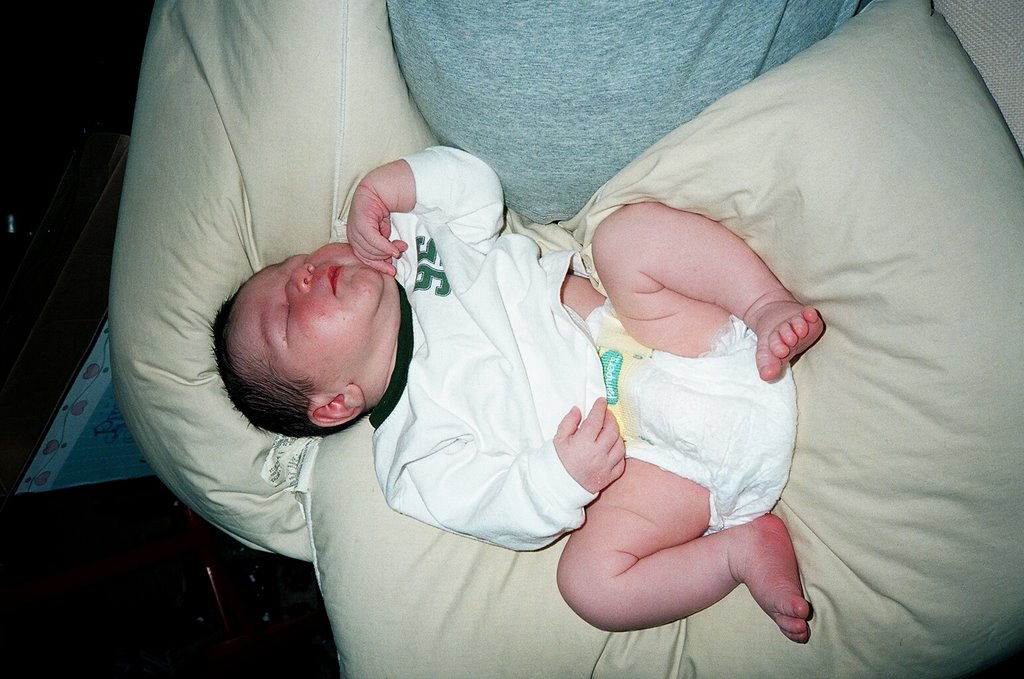
My brother and his wife just had a baby last week, and here are some pictures. Isn't he cute? I've visited him once since he was born, but since then I've disappeared back into a corner covered with knee-high piles of books and similarly high stacks of spiral binders.
Every time I do a major writing project, I say to myself that I will do all the footnotes as I go along. I was slightly more responsible that way this time around, but with about 150-200 footnotes per chapter, I still am spending a lot more time than I'd like making sure that every little detail is taken care of before I put the ms in the mail. So that's why I've been absent from the blogging world. However, the end is really in sight.
* * *
But, enough about me.
In honor of Benji's arrival,and in a somewhat shameless imitation of my friend Dave over at Axis of Evel Knievel, lemme take a look at some historical coincidences. Once I've done compiling, I will whiz the data all around and make a prediction about Benji's future.
Benji was born on the anniversary of a number of important historical events: On September 28 in 48 BC, the King of Egypt assassinated Pompey of Rome, (which you might have seen on TV if you watched HBO last year.) In 1066, the Norman Conquest began. On September 28th in 1542 - Navigator Juan Rodríguez Cabrillo of Portugal arrived at what is now San Diego. In 1787, the US Congress voted to send the brand new United States Constitution (at that points sans Bill of Rights) to the states for ratification. In 1928 on that day, the United Kingdom banned marijuana, and followed up by banning medical marijuana on Sept 28, 1971. Stalin and Hitler signed their infamous pact to divide Poland on that day in 1939. In 1958, France ratified the Constitution of the fifth Republic, and its colony, Guinea declared independence.And last year on this day, Tom Delay was indicted for violating election laws by a Texas grand jury.
Little Benji celebrates his birthday along with the following famous people: Carravagio, Ethel Rosenberg, Marcello Mastroianni, Ben E. King, John Sayles,Janeane Garafalo, Mira Sorvino, Koko Taylor, Al Capp, Brigitte Bardot, and Hilary Duff.
Benji's Mom is a believer in astrology, so I think we should add that to the mix as well. According to this computer generated chart
Benji is a Libra, with Pisces rising and his moon is in Sagittarius, and will be a creative, empathic, idealistic and perfectionist guy who likes everything to be beautiful and scorns ugliness. He works well with others, likes to have a partner for projects, but also likes to "get his own way" all the time, and yet he can't always decide what that way is.
So, let's stir up all the info....
I predict that Benji will be an artist, will not smoke marijuana, will be good looking, have great taste in clothes and interior decorating and since he's social he'll throw some good parties. He'll also be interested in politics, and at some point he will either found or conquer a new country, or both. Short of a new country, he may create a little community of like-minded people with its own rules, and with a beautiful decorating scheme, of course, perhaps out West. When he chooses a partner with whom to work on this project, his sensitivity and empathy will keep him from choosing someone like either Hitler or Stalin to be his co-founder. Don't worry Mom and Dad.
And that's my prediction. If I'm still blogging in forty years or so, I'll do a follow up.
Every time I do a major writing project, I say to myself that I will do all the footnotes as I go along. I was slightly more responsible that way this time around, but with about 150-200 footnotes per chapter, I still am spending a lot more time than I'd like making sure that every little detail is taken care of before I put the ms in the mail. So that's why I've been absent from the blogging world. However, the end is really in sight.
* * *
But, enough about me.
In honor of Benji's arrival,and in a somewhat shameless imitation of my friend Dave over at Axis of Evel Knievel, lemme take a look at some historical coincidences. Once I've done compiling, I will whiz the data all around and make a prediction about Benji's future.
Benji was born on the anniversary of a number of important historical events: On September 28 in 48 BC, the King of Egypt assassinated Pompey of Rome, (which you might have seen on TV if you watched HBO last year.) In 1066, the Norman Conquest began. On September 28th in 1542 - Navigator Juan Rodríguez Cabrillo of Portugal arrived at what is now San Diego. In 1787, the US Congress voted to send the brand new United States Constitution (at that points sans Bill of Rights) to the states for ratification. In 1928 on that day, the United Kingdom banned marijuana, and followed up by banning medical marijuana on Sept 28, 1971. Stalin and Hitler signed their infamous pact to divide Poland on that day in 1939. In 1958, France ratified the Constitution of the fifth Republic, and its colony, Guinea declared independence.And last year on this day, Tom Delay was indicted for violating election laws by a Texas grand jury.
Little Benji celebrates his birthday along with the following famous people: Carravagio, Ethel Rosenberg, Marcello Mastroianni, Ben E. King, John Sayles,Janeane Garafalo, Mira Sorvino, Koko Taylor, Al Capp, Brigitte Bardot, and Hilary Duff.
Benji's Mom is a believer in astrology, so I think we should add that to the mix as well. According to this computer generated chart
Benji is a Libra, with Pisces rising and his moon is in Sagittarius, and will be a creative, empathic, idealistic and perfectionist guy who likes everything to be beautiful and scorns ugliness. He works well with others, likes to have a partner for projects, but also likes to "get his own way" all the time, and yet he can't always decide what that way is.
So, let's stir up all the info....
I predict that Benji will be an artist, will not smoke marijuana, will be good looking, have great taste in clothes and interior decorating and since he's social he'll throw some good parties. He'll also be interested in politics, and at some point he will either found or conquer a new country, or both. Short of a new country, he may create a little community of like-minded people with its own rules, and with a beautiful decorating scheme, of course, perhaps out West. When he chooses a partner with whom to work on this project, his sensitivity and empathy will keep him from choosing someone like either Hitler or Stalin to be his co-founder. Don't worry Mom and Dad.
And that's my prediction. If I'm still blogging in forty years or so, I'll do a follow up.


Subscribe to:
Posts (Atom)