Saturday, April 30, 2005


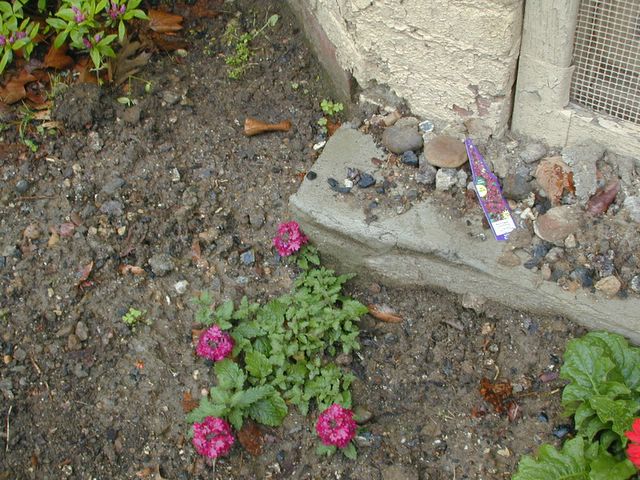
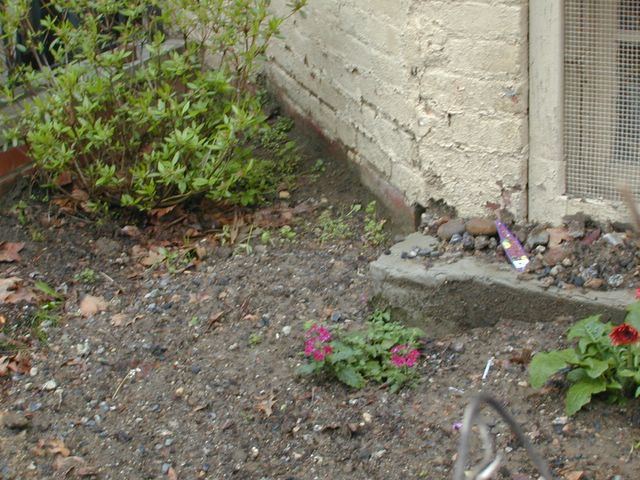
that big purple flowering thing has a name, I can't remember what. I hope it grows tall. I planted a bunch of cosmos seeds along the wall here.Between the gardenia bush and the purple dr. seuss-looking thing, there will be huge lilies. They'll come in late summer from the bulbs the landlord put in last year. Posted by Hello

that pruned and stunted azalaela is free of disease and ready to bloom. Posted by Hello

tiny rose bush Posted by Hello

Since my last garden post, I've added some plants, including a miniature rose bush. Everything's happy in the rain. The big rose in the middle, and the two large bushes were planted last year, by the landlord. He knows what he's doing in the garden. Posted by Hello

There might eventually be some hollyhocks here. Posted by Hello

watch this space. Here's where the morning glory seeds went.  Posted by Hello

Seeds, Bugs, Grisly Movie Murders

So, another day, another movie. Soon the Tribeca film festival will be ending, and I will have festival withdrawal. Today I got in some mandatory outdoors time looking at my plants as they thrived in the rain. The other day, when it was sunny and windy, I planted some seeds: hollyhocks, morning glory and cosmos. This was a new frontier in gardening for me. I even nicked and soaked the morning glory seeds to help them germinate. Seed germination is fascinating, I think. When I was a kid I tried to growing things from seed and they pretty much failed, all except the corn I grew in our backyard, which matured and got silky and everything, but when I opened up the ears they were completely filled with bugs. I was so traumatized that I never gardened again. It's these childhood tragedies that one must work through.
So speaking of childhood tragedies....last night I went to the most devastating movie I'd seen in the film festival, one that was created initially because of the film-maker, Fanta Regina Nacro's tragedy. Her uncle was murdered by being slowly barbecued to death. As you can imagine, when I begin with this detail, "Night of Truth" (or Nuit de la Verite) was grisly. It was set in a fictional African country in the wake of an ethnic war between the fictional "Nayaks" and "Bonandes." The script was very tight and obviously influenced by Shakespeare. It raised an important issue in the motivation of genocide, the same thing that I saw in "Bastards of the Party," that idea that the killing in such wars becomes personal, about revenge, and is not motivated by any larger political, or even economic concerns. The Nayak president's wife sits at the graveside of her son, at the beginning of the film, haunted and enraged. Bonande children sit in circles in the other region, trading stories of their hands or legs being amputated, their parents being killed. They are all to meet that night to make peace with the enemies, but while the leaders think it best, the armies, the children, the followers are unable to let go of the hatred of the war. In addition to liking the film, I'm happy that it marks the growing prominence of African film-makers.
To completely non-film related things. I was talking to someone the other day who speculated that George and Laura Bush must have a great sex life. This is something that I find repugnant to think about. What are your speculations? My guess is that both of them are uptight prudes, but I could be wrong.

Friday, April 29, 2005

news flash!

I usually limit this to one post (and one hour) per day, but I just had to post an extra edition. More good music on Goodman's show. "Meu Sapato ja Furou" by Clara Nunes, one my favorite samba songs ever. amazing. What has happened? I guess change is possible.

"The F Word,"

I heard something about a press-conference last night. ick.
How appropriate then that yesterday's movie was "The F Word." It was pretty great. It was shot in nine days and cost $6,000.00 to make and, in homage to Haskell Wexler's Medium Cool, it combined actors and real people who came in and out of protests at the Republican National Convention last Summer. I was impressed at how good the thing looked - given the "man-on-the-street" quality of it. The basic story was a guy walking from lower Manhattan to Central Park, on the premise that he was a radio host whose show was going off the air because of FCC fines. One of the luckiest parts of the film was that the film-makers managed to be there when that dragon caught on fire in front of Madison Square Garden in a still-murky accident. The charges against Josh Banno, who was accused of lighting the fire were recently dropped. They also got some great footage of very brutal arrests of Critical Mass riders, which they inter-cut cleverly with Mike Bloomberg's hypocritical speech at the convention. My labor union activist friend who joined me for the film wanted very much to know, was the "construction worker" who argued in favor of Ralph Nader at a hot-dog stand in Tompkins Square park real? I found out that indeed, he was an actor.
Unfortunately, the idiot from Gawker who went to the premier party didn't know anything about the left in NY, knew so little in fact, that he wondered why some "left-Jesus Freak" deserved to be in a movie when Rev. Billy was pointed out to him. I guess Gawker's writers don't even read the NYT It bugs me that someone who doesn't do any work can have so many readers.
Bizarrely, some people that I vaguely know were in the movie. There was of course, indie-actor Ed (now "Edoardo Ballerini"), who was in my circle of friends, and with whom I once had a big fight at Wesleyan. I don't remember what it was about, but I proudly disliked him from then on. He recited a Walt Whitman poem during the dream sequence... Then there was Owen, who I recall meeting in Minnesota; he was an ex-Special Forces marine who was spending as much time as possible in Cuba, and when mention was made of his ex-marine status in the post-film Q&A I realized that the vague familiarity that I felt while he was on-screen was not in fact a wannabe-friend-of-movie-people fantasy. And yes, it was my email pen-pal in that first scene, sporting a beard in the bell-ringing protest. I had thought I was imagining things.
And now, it's time to stop blogging...Once again Amy Goodman has found some good music, defying her usual bad musical taste -- a montage of different people singing "Brother, Can You Spare a Dime." (on this link, you can hear Studs Terkel interview Yip Harburg about the song.

Thursday, April 28, 2005

Mayibuye....Africa!

Tonight I saw a really fantastic film, Lionel Rogosin's 1959, clandestinely made "Come Back, Africa," about which he wrote a book that is now published.
The post-film Q&A was lovely. Rogosin's wife explained quite a bit about how the film was made using all non-actors, and under false pretenses. The fact that they were able to process the film and then send it to NY is pretty amazing. One of my guests at the theater told me that she had gone to highschool with Makeba's daughter. The film gave a devastating and very true picture of life under Apartheid, and reminded me of how I felt so conscious of the terrible injustices there for years and years in high school and college. I felt so passionately about what was going on and felt every day that I was party to a crime - that a crime was going on that I had to do something about. Now, more thanten years after the fall of Apartheid, conditions in the townships are still bad, as my friend Premesh would explain in detail. There are still conditions around the world about which, when I think about them, I have that same feeling; only now, I have less of a sense of my own capacity to have an effect. The comparable, wretched, hateful situation is in Israel/Palestine, where today settlers are protesting the most limited move to pull them out of their outposts on Palestinian land. Given the fact that the wall is well on the way to completion, I still conclude that historical conditions have not yet pushed Sharon into the deKlerk position on the eve of Apartheid's end. I certainly hope that I am wrong.

Wednesday, April 27, 2005

Literary Personals' Ads, Movie Comments: "Based on a True Story" and "American Ruling Class"

My friend Wigz alerted me to a blog entry about the personals ads in the London Review of books. They are funny. This conversation reminded me of how humorous I used to find the New York Review of Books personals, which all seemed to describe the same people. My recollection, without looking, is that they were fifty year olds with progressive politics, pets, and a penchant for the writing of Iris Murdoch/Flannery O'Connor, etc. Let's see, has anything changed? (just a minute). After checking this group, it seems that the hobbies are more outdoorsy, the age range remains the same, and the self-promotion seems to have increased. I notice a lot of the women describe themselves as "beautiful" - I don't think I would do that.
Yesterday I saw two movies: Based on a True Story, a documentary about the bank robbery and the robber upon which the movie "Dog Day Afternoon" is based, and "the American Ruling Class," a sort of star vehicle for Lewis Lapham of Harper's Magazine. (they have a very limited personals section).
I enjoyed, but was a little disappointed with "Based on a True Story," because I had remembered seeing fascinating clips from another movie juxtaposing "Dog Day" with the memories of Wojtowicz, which turned out to be Pierre Huyghe's film The Third Memorywhich I had seen pieces of at the Guggenheim's big "moving image" show a few years ago. Unfortunately, no mention was made of this 1999 film in the newer one. However, since the focus of Stokman's "Based on a True Story" was a set of phonecalls with Wojtowicz in which he demanded increasingly large sums of money for the privilege of his visual presence in the film, I can hardly blame Stokman for not doing what Huyghe did, and I wonder how Huyghe managed to work with "the Dog." Stokman's was more of a documentary because it did involve interviews with other people in Wojtowicz's life, many of whom came to the screening. Because of this film, I noticed when later, at Yaffa, Wojtowicz's ex-wife, Sharon, walked in the door with some friends. I felt great sympathy for her, as she failed to see who her husband really was, and still wanted to "get back" with him in the early 70s despite his marriage to a transsexual.
More disappointing was "The American Ruling Class," an arch film which really needs a major edit. There seems to be a bit of a conflict within the film about its meaning, as this New York Times piece suggests. The film, which my friend said was a big "apology" by Lapham for being a member of the ruling class himself, does have a little of that flavor. It is not filled with the same bizarre self-congratulation and self-hatred that you see in David Brooks' "work;" it is a lot more funny and more true. The best pieces, (oh future editor...Hear me) were the interview with Babara Ehrenreich in the IHOP, the rock video of workers singing "nickel and dimed." (I had so many friends who didn't like that book because of the idea of someone "playing working class," instead of just interviewing working-class people. The interview reveals Ehrenreich's sympathies and her interest in the people she works with) - the party scene with the trust-funded public defender arguing with her investment banker college friends, the moment when the naive Goldman Sachs hire was asked "where were you educated?" by Walter Cronkite, because of his shocking naivete, and the interviews with James Baker and other members of the power-elite. I noticed that as Jack went through the levels of the ruling class that people highest on the ladder denied the reality of the ruling class, while liberal intellectuals such as Kurt Vonnegut and Cronkite had no problem belieiving in it. There was a lot in this film worth keeping, but it should probably get shorter by about 30 minutes.

Monday, April 25, 2005

Anything to Declare? Movie Comments

This was a set of intimate films all done by students of film-maker and teacher Graham Weinbren, an unassuming fellow, who said during the Q&A that he'd made so many films that he now vowed only to make 1 minute films. Two of these opened the group of films: Q and L, part of a for series of filmseach letter of the alphabet- beautiful.
The films by his students were "Gay Motherfuckers" a sort of artfully filmed hang-out with a group of FTM folks, butch dykes, "biomen," and lesbians talking about masculinity and their own identities, which was cleverly edited to produce both insights and hilarity; "Photo of Luzmilla," the story of a family whose mother's picture was part of a special photo exhibition about Peru called Yuyanapaq: To Remember.
This film, which featured interviews with Luzmilla's two sons who were tortured by the Peruvian police, was very powerful. The older son talked about his experiences of torture somewhat matter of factly, recalling "it was terrible" when.. "they stretched my bones on that pulley, when they tried to drown me in a bathtub full of excrement, when they hung me. If I had to go through it again, I would rather die." The film-maker edited it so that his voice-over played as he walked through the streets of Washington Heights, "once a person has been in prison living only with "a couple of rats"....we are changed forever, we can't concentrate, remember...Even though I am in NY, I don't feel safe." As I was hearing them I thought, "how terrible and yes, how true," and wondered also how many people walking the streets of NY have gone through such harrowing experiences. As I write these statements now, I also think, "aren't these the symptoms that they describe for "post-traumatic stress disorder?"
The younger son was outwardly more expressive about his experiences, crying as he remembered being tortured and made to sing the police anthem while in prison.
The final film, Negotiations, was an intimate set of discussions between a couple, one Israeli, one white American born ot Lutheran missionaries in Japan, talking about the imminent birth of their first child, what the name will be, whether ot have amniosentesis, whether the child will speak Hebrew or English. Very fascinating and touching. It was shot all over the place - the midwest, Israel, and NY, and really investigated both the kinds of differences between people that seem universal to human relationships and the special circumstances arising from a cross-cultural relationship such as theirs.
Tomorrow...two films! Tonight: one video 'Dog Day Afternoon" in preparation. Tomorrow, I will be sleepy.

garden diary day two Posted by Hello

sundial mix garden diary day two Posted by Hello

front corner, day two Posted by Hello

planter, day two Posted by Hello

the big picture, garden diary day two Posted by Hello

Sunday, April 24, 2005

Gilaneh, "Bullets in the 'Hood," "the Life of Kevin Carter"

The films I liked best at the Tribeca Film Festival today were all about terrible, wrenching, pain.
Gilaneh, directed by Rashkan Bani-Etemad (whose name was spelled incorrectly by Variety, by the way) and starring Fatemeh Motamed Arya was brilliant and heart-breaking. I found an interesting article about the major Iranian film festival which places Gilaneh in context. The film centers on Gilaneh, her son and her daughter, and their efforts to survive the Iran-Iraq war of the 1980s. The first section shows the son leaving for the front as mother and pregnant daughter stay behind in the village. Eventually too panicked about the whereabouts of her husband, Gilaneh's daughter Mogyul demands a journey to Teheran, which takes the two women past groups of refugees fleeing Iraq's missile attacks. The second half of the film takes place back in the village, on the first day of the US bombing of Iraq and centers on the terrible condition of Gilaneh's son, who after the war was left paralyzed, with some kind of severely compromised lung capacity, and subject to fits. Increasingly labored herself, Gilaneh attempts to take care of her damaged son. Fatemeh Motamed Arya gave an incredible performance, that I would compare a little bit with that of Imelda Staunton as Vera Drake.The two characters are similar in their steadfastness and stoicism.
The other films I saw today were short ones. OF these, two were really special: "The Life of Kevin Carter," about the photographer who won the pulitzer prize for that truly disturbing photo taken of a child crawling to a UN food mission and being followed by a vulture. Seeing in the film that Carter watched the girl get up, fall and try to walk, only to fall again, and seeing other pictures on the contact sheets, it seems terrible to me that he did not help her. Some people, both in the film audience and in the film say that the photograph was so great, that it would have done more than simply lifting the child up and carrying her to the station by telling the world of the situation, the argument doesn't make sense to me. It's hard not to feel, when looking at the photo, that what you're seeing is not only a picture of starvation, but the moment when a photographer lost his humanity, as this person's suffering became only "the big photo" that would make his career. If you're interested in what other people had to say about this issue, go to the link above and read the list of comments on lavannya's blog, "secrets of my inner world."
The polar opposite of the Carter's detached approach to documentary was the remarkable Bullets in the Hood, a movie shot by Terrence Fisher, which began as an anti-gun documentary, in which he interviews various neighbors in the Bed-Stuy projects and gets them to show him their guns, but became an activist cry for justice when Fisher was present at the shooting and killing of Timothy Stansberry, by the NY housing police. Unlike Carter, who was not a part of the communities that he became famous for photographing, Terrence Fisher and his crew were documenting their own lives and surroundings and for this reason they could not be detached. As this film's maker responded to events by changing the nature of the project, and made the project specifically an activist one, it was a great example of how amateurs, untrained in the "professionalism" of the journalistic world, bring a different attitude to the process of documentation. The line between protesting the death of a friend and making a film about gun violence in the projects was competely gone by the time the directors, crew, and Stansberry's mother got on the stage to talk about the film/issues after the screening was over.

I hope these grow. I like these lettuce-like sunflower things and of course, the verbena. Posted by Hello

The planter Posted by Hello