Monday, February 20, 2006

New Heights of Absurdity

An anonymous reader brought my attention to this new effort to pass a sedition law in the US, as a noble successor to two previous unconstitutional pieces of legislation: the Alien and Sedition Acts of 1798 and the Sedition Act of 1918.

Meanwhile, I got this notice in my mailbox today alogn with several other MLA calls for papers, I particularly like the part that says: "Intellectually rigorous approaches that avoid the familiar ruts of conference papers--inspired by the research methods of the surrealist project, for instance--are particularly welcome"


UPDATED DEADLINE: 3/10/06

Announcement and Call for Papers

The Lebowski Cult: An Academic Symposium
28-29 September 2006
The Executive West
830 Phillips Lane
Louisville, Kentucky

The aim of this small symposium is to invent a critical program equal to
the task of interpreting The Big Lebowski (1998) and addressing the
Lebowski cult that has quickly grown in its wake, both the legions of
more or less public fans as well as the cultural politics, resonances,
and after-affects of their fanaticism.

The 5th Annual Lebowski Fest (http://www.lebowskifest.com/fests.asp)
scheduled to follow the symposium, September 29th & 30th, will be
included in the conference registration.

The organizers invite papers ranging in approach from the theoretical to
the documentary, from alternative historicism to cultural phenomenology.
Intellectually rigorous approaches that avoid the familiar ruts of
conference papers--inspired by the research methods of the surrealist
project, for instance--are particularly welcome on Lebowski and the
following topics:

Auteur Theory and Cult Film, the sixties and the nineties, Creedence and
The Eagles, Bob Dylan and Kenny Rogers, Logjammin and Gutterballs,
Fluxus and the Brunswick aesthetic, fans and audiences, the hard-boiled
and the postmodern, nihilism and existentialism, the Port Huron
Statement, Malibu, Busby Berkeley, Saddam, The Long Goodbye, Nixon,
bowling, Tara Reid, The Big Sleep, Vietnam, hippies, the Jesus,
language, citation, catch-phrases, cliche, coinage, dreaming, "smart"
films, irony, the last Western, Los Angeles, or what-have-you.

An abstract of about 500 words as well as a brief CV should be e-mailed
(in the body of the e-mail: no attachments) by March 1st, 2006, to both
Aaron Jaffe, Assistant Professor of English, University of Louisville,
a0jaff02@gwise.louisville.edu, and Ed Comentale, Associate Professor of
English, Indiana University, ecomenta@indiana.edu.

As the symposium will be held in a local bowling alley, participants
should arrange to bring appropriate footwear or be prepared to rent on
site.


Yes, I suppose it's funny, funny in the way that the rest of hipster-irony is funny. Oh, I'm so glad to see my fellow-academics are striving to achieve such relevance in this time of world-wide crisis. It's heartening to know that at least one of the coordinators of this symposium actually has tenure at a major research institution. That must be because their work is so very, very rigorous and challenging.

The Devils' Miner: Movie Review

Yesterday afternoon, I went to see the film, "The Devil's Miner" at MOMA. This is a devastating film about child labor in the silver mines of Potosi in Bolivia. It is similar to the extremely popular film of last year, Born into Brothels, in depicting children whose situation seems hopeless and whose living and working conditions are nearly unimaginable to the average middle-class viewer. The focus in "the Devil's Miner" is Basilio Vargas, a fourteen year old boy who works 12 to 24 hour shifts in the silver mine of Cerro Rico,and is the primary bread-winner in his small family. We are told at the beginning of the film that this mountain in Bolivia, where silver mining has gone on since the time of Spanish colonialism, has killed 8 million miners, and thus is called "the mountain that eats men alive." Even when not killed by accidents, miners typically die in their 30s and 40s because of silicosis.
In keeping with the precariousness of the mines, the miners maintain shrines to "Tio," a horned god/devil, to whom they make sacrifices of coca leaves, liquor, blood, and cigarettes, asking for protection from mine accidents and praying for a strong vein of silver. At several points in the film, you see Basilio and his 12 year-old brother, Bernadino crouching in front of Tio in his special corner in the mine, chewing coca leaves talking about their fears of accidents. Strangely, even though Basilio tells Bernadino that Tio originated from the Spanish, who created him to force the Indios "who feared all kinds of different Gods" to go back to work after a major rebellion during the colonial days, he still believes in him, makes him offerings, and wants his younger brother to learn how to make offerings to Tio too.
Seeing these tiny boys travelling into the dark, rickety silver mines with their chisels and headlamps is simply heartbreaking. I thought that the evangelical free-marketeers should be forced to watch this movie with their eyelids propped open "Clockwork Orange" style, so that they might be sympathetic, if not to the plight of young children in the greedy maw of international capital, at least to what they would see as their immortal souls.
According to the web-page of Kinder Not Hilfe," a German aid organization dedicated to helping the children who work in the mines, there are about 6500 children working in the Cerro Rico mines today. This film, in addition to providing the privileged with a glimpse into the world that's supporting our excessive consumption, reveals the consequences of free-market economics. Why does Basilio have to work in the mine? Why, because his father died. With no male breadwinner, his family depends on his income. A society with a welfare state would prevent the desperation that leads 6000 little Basilios into the mines every year. Why does the mine still eat men? It's not because of copious profits. This particular mountain has long given up the majority of its silver, but it remains the best or perhaps, the only option for those miners' cooperatives who still go in day after day to the "antique" mines, hoping to scratch a living out of minimal amounts of precious metals. If Bolivia had not been forced into austerity reforms and privatization in the 1980s, perhaps those men in the mines would be working in farming villages or in craft collectives, like Basilio's father, who had been a blanket weaver. Why would anyone go into a spent mine to make a living if there were any other choice? Working in that mine is something like living on the edge of a garbage dump in Tijuana, only more dangerous.
While the film is moving and displays the tragedy of child labor in the mines, it does not provide enough economic context for most viewers to make sense of the problem. It would be easy enough to leave the film with the idea that groups like the US-based CARE, which tries to eradicate child labor by "educating" the poor about the importance of going to school, etc., are actually doing something useful.
However, for the curious, "The Devil's Miner" can lead to a search for background information, and does provide some context for the recent political victory of Evo Morales, which has been, as usual, poorly understood in the US.
Seeing the film made me want to know more about Bolivia, and the city of Potosi, which supported Morales. In my google-fest this morning, I learned that Potosi was also at the center of recent protests against water-privatization schemes that Jim Shultz of the Democracy Center in Cochabamba describes here and in his "Blog from Bolivia." Also worth reading is Nick Buxton's "Open Veins" blog, which takes its title from Galleano's classic.

Thursday, February 16, 2006

What's Not Acceptable

I just got done reading an important message from my union president about the ongoing negotiations over the CUNY faculty's contract. (it might take a while for the 2/16 update to hit the webpage - so if it's not there when you check the link come back later.)

There's a lot in it this latest report from contract negotiations with CUNY management to provoke anger.

To catch you up to speed, here's the context. Our union is called the Professional Staff Congress (PSC) and we represent CUNY's faculty. Our most recent contract expired on Halloween of 2002. For two years, the administration made no financial offer at all, despite efforts at bargaining and proposals by the reps. of the faculty. THEN, in December of 2004, management offered us a 1.5% raise over four years and a set of major give-backs. One of management's most obnoxious demands was that the department chairs become administrative positions and no longer part of the faculty. For faculty governance, hiring and tenure decisions, this would be a disaster. Other demands included the idea that members of the bargaining team would not be allowed to take notes during bargaining sessions. They wanted us to return early in the Summer, and they gave us nothing for health care benefits, which are already minimal. (no dental coverage, for starters).

As you can imagine, we weren't interested.

So, the biggest problem is management intransigence, which is part of a larger pattern in city employee contracts recently, but another problem has been the lack of a coherent campaign on the union's behalf for this contract. When the University made their insulting offer, people got mad, and there was a serious effort to create real action within the union to push for a good contract. Unfortunately, while I believe that the leadership wants to involve the membership, the organizing efforts have not been as strong as they could be. Our first actions went little beyond weekly phone calls to various members of management, not a tactic that brings faculty together in something that feels "collective." Members complained at meetings that there must be "more" that we could be doing, and were indeed eager to do it themselves.
Things began gathering steam as union members (and leaders too) started talking about creative actions that we could take. Meetings and training sessions were held and energy began to build in the Spring of 2005. While there was a concerted desire for more action and genuine frustration with the university's offer, the engagement of that frustration in the membership was inconsistent. Plans began, were tried briefly, and ended almost before they began - before they had a chance to work.
The most serious of these plans of action was the notion of a vote on a job-action (an action on the job affecting work that could include anything from grading papers in public to not turning in grades, to going on an all-out strike). While risky, this idea did lead to an impressive mass membership meeting and a series of conversations with faculty members, but there was not enough turnaround time or continued effort to build it. Building for something like a job action can't be done for two months and then stop just in time for a bargaining session. But that's what happened. Just as the work seemed to be starting, organized events and discussions within the membership ground to a halt while we waited to see just what was going to happen at the bargaining table this time.
In the end, the provisional agreement reached in November of 2005 did involve an increased financial offer, but it made concessions to management (such as changing the time to tenure from five to seven years and adding a full office hour to each week for full-time faculty) about which the membership was not informed until last week. I see this offer as less than what we could have gotten, even in today's harsh climate. Now, however, the University has gone back on its word, and returned to the bargaining table today with a different offer from what was agreed to back in November. During the entire time between the Nov. 14th agreement and the present reneging on the administration's part, there has been almost no organized action by the union. Now, management has left concessions (like extra time to tenure and additional office hours) on the table, but has taken back compensation offers for those changes that had been part of the agreement in November.
What happened??
I believe that the focus on the act of bargaining itself, and the belief that the most critical action is taking place at the bargaining sessions is the reason for this paralysis in our union. Member action, instead of being the focus that really drives the leadership at the table, has become a cheerleading section for whatever is going on at the table, and action starts and stops around the schedule of bargaining sessions, stopping? during or right after sessions at times almost as if too much action might somehow "jeapardize the process." This notion of the bargaining session as in itself the center of the struggle (rather than say, the public square or the workplace) has both immediate effects, such as a contract campaign that "starts and stops," or does a "hurry-up-and-wait" around the bargaining sessions, and more long-term consequences. The focus on the action around the table reinforces the notion that the union is a service organization that exists to "get" the faculty a good contract. No matter how much the leadership says in speeches that the membership actions are "what's putting pressure" on management during the sessions, the fact that every union meeting is focused on reporting to the membership about "what's happening at the table" leads to a feeling of spectatorship and powerlessness among the membership.
The fact that none of us even knew what was in the tentative agreement when it included such a whopping concession as two years added on to our time before tenure adds even more to a dynamic that separates the membership from the union leadership and throws us into a position of dependence. It's likely that the union was legally bound by some agreement not to talk to us, but I find this strange. Why shouldn't we be asked about whether we think it's a good idea to add time to our tenure clock?

But, you might ask..."isn't the bargaining table where the contract is decided?"
The answer is, Yes, of course it is. But - the power of the CUNY faculty is not predominantly located at the bargaining table. It exists in two places: first, in the workplace and secondly, in the city at large. While it may be illegal and difficult for us to engage in a succesful "job action," it should not be difficult for us to make an effort with our larger "social" power. We are a public university that serves more than 400,000 students in 19 different colleges in New York City. The public respects and cares about this institution, and yet there has been seemingly no outreach to the public through the media, or even mass demonstrations that target the people who might support CUNY (rather than members of the bargaining team) to bring this public pressure to bear on the city. It's a major missed opportunity to get the city on our side. Finally, a consistent, ongoing, and obnoxious campaign for ANY particular strategy is bound to put more pressure on management than a campaign that stops every time the leadership hopes that something's really happening "at the table," just as maintaining ongoing one-on-one organizing conversations with members about strategy and goals (regardless of what's going on at the table) is essential for building faculty support that will make the union stronger in the long run.
Meanwhile, it would help if you
write a fax to these guys (follow the link to the PSC website to send faxes to the Governor, Mayor and CUNY chancellor.

Wednesday, February 15, 2006

Shocker: Christopher Hitchens "Really Unprofessional"

Brian Lehrer just made the understatement of the week. I'm listening to his show while finishing up my tax returns, and heard him say that he though Christopher Hitchens was "really unprofessional" to have given "the finger" to audience members during a debate with David Corn about the Iraq war.
Quel Surprise!

Tuesday, February 14, 2006

Anxiety Index: Past the Tipping Point

It's sweltering in my over-heated with fossil fuels NY apartment and it's reminding me of what I read in the news on Monday about the impending end of life as we know it. According to an article in the Times Independent, we've already passed the tipping point.
While this goes on, corporate shills like Bjorn Lomborg, who was found officially "dishonest" by the Danish committee on scientific dishonesty remain beloved and influential and maintain a fictional "debate" about the seriousness of global warming.

Drunken Dick?

I wasn't able to blog on Monday because of some problem with blogger, so I have an extra post to squeak in tonight or tomorrow, but I couldn't help adding to the new comment on Saturday's blog entry.
I was just saying to my room-mate that I suspected that Cheney's friend's shooting wasn't as was reported. Once I heard that the Quail hunt was a drive-up and shoot hunting event on the source of all things true, The Daily Show, I wondered even more. So here's a scenario: Dick and the boys are in the lounge, knocking back whiskey, discussing whether he'll get in trouble with the Special Prosecutor for telling Libby to leak Plame's name. Whittington cracks a joke Dick doesn't like, and scowling, the veep raises the shotgun, growls some obscenity, and (whoops!) shoots his friend in the face. 24 hours later, we hear the first reports.
Then, I saw that someone had posted this now deleted story in which the hunting-hostess, Mrs. Armstrong, denied that the boys had been drinking.
After all, he was arrested on drunkenness charges three times in the early 60s.
Maybe I'm making up a wacky conspiracy theory, but who is there to say that things went down the way the people in power said they did?

Sunday, February 12, 2006

Good Thing He Keeps those Paramedics Around

In the shooting "accident" this weekend, did anyone else notice that our (vice) President regularly travels with a host of emergency personnel? Following the shooting of his friend, according to vp spokeswoman, Lee Ann McBride....

"Fortunately, the vice president has got a lot of medical people around him and so they were right there and probably more cautious than we would have been," she said. "The vice president has got an ambulance on call, so the ambulance came."


Does anyone else find it troubling that the VP's health is so precarious that he goes hunting with emergency personnel and has an ambulance on call? That seems to me at least as newsworthy as the incident itself.

Friday, February 10, 2006

What Makes Someone a "Democrat"? or....with Democrats Like These, Who Needs Republicans ?

I was just reading the NYT online when I came across this article referring to Michael Bloomberg as a "democrat" in Republican clothing. While I've given up being conned by any notion that either of the bourgeois political parties actually represents the interests of the working class, it does seem to me that this article provides us with a good way to talk about what the Democrats once were and what they've become. The issues that the author of the Bloomberg article describes that make Bloomie a "Democrat" are gun control, stem cell research, more generous public school funding than George Pataki, and endorsing Democrat in a state senate race. With the exception of school funding, these issues are mighty particular - and cultural ones - on which to define party lines. Even in the age of Jackson, the one of the primary constituencies of the Democratic party was white organized labor. Since the 1930s rise of the CIO and the New Deal, you can add Black urban workers to that constituency, and after 1964, you can add African Americans more generally.
Bloomberg's behavior towards municipal and other workers marks him as an arch-conservative plutocrat, and in my opinion, that's more important than Stem Cells as a dividing line. If being a democrat only means opposing the evangelical right wing (stem cells), then being a Democrat today means being slightly to the right of those termed "Rockefeller Republicans."

Wednesday, February 08, 2006

Bizarre Result from Intelligence Squared Debate on Iraq

Unless you're British, it's unlikely you know what that headline refers to. Intelligence Squared is a popular British debate series featuring provocative proposals, well-known debaters, audience Q&A and voting before and after the debate. I happened upon them through audible.com, where I have a membership. I decided to check out the debate on the proposition "The Time to Quit Iraq is Now" held on January 17th of this year. The debate itself was riveting. The debaters were Rosemary Hollis, Simon Jenkins, and Alistair Crooke for the affirmative position and Amir Taheri, William Shawcross, and Lt. Colonel Tim Spicer against.
Rosemary Hollis, of Chatham House, argued primarily from the position of British self-interest, saying that the situation is about to get even worse and much uglier, and the British should exit before this happens.
Alistair Crooke talked about the growing power of Iran, and argued that the "atmosphere of civil war" is being created by the occupation force's support for a government which is suppressing the Sunni. He said that the longer the US and Britain stay, the harder it is to create a legitimate government. Jenkins summed up the position well, saying that what his side had to prove was: "the longer we stay, the worse it gets." He was the most expressive speaker, describing the occupation as a "military squat," not an occupation, despite how much money is being spent on the war.
On the negative side, Tim Spicer, a private contractor! in Iraq, delivered the standard argument that the insurgency is composed of criminals, former Baathists, and members of Al Quaeda, and that the Iraqi security forces are a viable force that is "making great steps forward," but it is "not yet ready." Amir Tehari, the strongest speaker on the "stay the course" side, is a major neocon, NY Post and National Review contributor, played the heartstrings of the audience with all kinds of appeals to the "Iraqi people," who he says want the foreign troops to stay to "keep their bargain" with the Iraqis. To listen to Tehari, you'd think that the Iraqis were begging the Americans to stay and protect them from a foreign insurgency. There's hardly much to say about William Shawcross, who's sort of the sober man's Christopher Hitchens. A lot of bluster, and not much substance. The fact that people can remain ignorant enough to listen to such piles of horseshit when their own citizens are dying for it just flummoxes me.
To my great surprise, after what seemed to me much less ideological and more informed comments from the affirmative speakers, none of whom was compromised by being a private contractor in Iraq such as Tim Spicer, the speakers against the motion won by a fairly large margin, and this in a country where polls continually reveal opposition to Blair and to the war. My only explanation of the vote would be that the audience members who voted to stay really believe that staying longer will somehow "fix" the mess, and that this vote represents people's sense of obligation to the Iraqis, whose country is now a shambles. Since both Brits and Americans seem quite suspicious of government motives when they are talking about tax policies, I find it odd that they view this very same government's motives as benevolent when the policy is foreign and military. Do they just think the government can be trusted more when its face is a teenager with a gun?

Tuesday, February 07, 2006

The Work Of Peace-Making Must Continue Until the Last Gun Is Silent: Coretta Scott King Remembered

I came home from work today fully intending to sit down and diligently read about the history of the American west, but discovered that while I'd been out, there was a major media EVENT.
You KNOW what I'm talking about: Coretta Scott King at center stage. First there was the funeral, the speech, the standing ovation, and now, the Republican pissing and moaning, and the leftie response. (that one has a link to other speeches as well).
I think, given the uproar from others, who may not have known that Mrs. King gave her gay male secretary leave to go protest at homophobic crackerbarrel restaurants, that it's worth hearing from Coretta Scott King herself and to some people who actually knew her well. (links below include audio of speeches and articles about King)

Here she is about the Vietnam war. First she's speaking at anti-Vietnam war rally following her husband's death in 1968, and again at anti-war rally on International Women's Day in 1971:

"The work of peace-making must continue until the last gun is silent"

..."The war is an enemy of the American people."


Here's what she has to say about gay rights and gay marriage:


I still hear people say that I should not be talking about the rights of lesbian and gay people and I should stick to the issue of racial justice... But I hasten to remind them that Martin Luther King, Jr., said, 'Injustice anywhere is a threat to justice everywhere'.... I appeal to everyone who believes in Martin Luther King, Jr.'s dream to make room at the table of brotherhood and sisterhood for lesbian and gay people


Here are some recent reminiscences about King from her close friends, some audio clips of speeches and interviews, including references to her ongoing activism and opposition to the Iraq war. Here's what she said on the eve of the invasion in 2003:
"I believe that more people are thinking about him and yearning to hear his voice because of concerns about terrorism and the buildup of war," ... "When you use war as a way of settling disputes, you only cause more war,"..... "In the long run, the only way to have peace is to use peaceful means."


And here she is on the relationship between the "personal" and the "political":

I married Martin Luther King Jr. because I came to love him after I met him, but I also married the cause that we both shared and the commitment, and so that made it possible when he was no longer here for me to continue because I understood what Martin Luther King stood for... and I felt that Martin himself was the noble example of what human beings could achieve, and I was hoping that we could raise up younger generations of people who would follow in Martin Luther King Jr's principles of non-violence and methods to bring about social change and to create the beloved community that he envisioned.


Now, tell me if you think she wouldn't have enjoyed those political speeches given at the celebration of her life and work.

A Cheap Excuse for a Blog Entry, but a Good Article

In the waning window of time before my departure for work, let me recommend reading from the London Review of Books. Eliot Weinberger's "What I Heard About Iraq in 2005" wins my vote for best year-end article from last month. There's probably something redundant about listing your favorite "year-end" article.

Saturday, February 04, 2006

On Flying a Struck Airline

The headline today may say more than enough, but read on. I'm writing from Michigan where I just arrived on NWA (I wasn't the one who bought the tickets) which is not only currently flying "scab," but also threatening an even worse situation for its non-striking pilots and flight attendants, who face heavy pay cuts in the latest contract offer. In response to NWA's pleas of bankruptcy and crushing concession demands, pilots, flight attendants, and several other workers at NWA have organized Airline Workers' United. This move, which plans to go industry-wide, holds hope for the labor movement.
The most significant contribution the rest of us can make is of course, not to fly the damn airline. I hate flying anyway, so it shouldn't be too tough in the future. But with the way that the airline industry operates these days,it's hard not to fly "scab air."
Of course, there are the basic moral reasons to avoid flying scab-air, but there are also basic selfish ones. Here's my experience if you needed another reason not to fly a struck airline.
The airline is stretching its workers so far that they delayed my brother's evening flight for TWELVE hours in order to provide pilots with the FAA's mandatory "crew rest." Immediately,I was sure that the incapacity to drum up another crew must be related to the cutbacks and layoffs at NWA. I looked up more info on "crew rest" related delays and see,in the phenomenon, a trick on the airlines' part. They fought the FAA regulation, which is a basic safety precaution, so instead of organizing flight schedules and employees to give adequate hours of crew rest, they must just blow it off, do it at the last minute, in order to build up customer annoyance with the crew.
To read more about how pilots generally are reacting to changes in the airline industry, read the airline pilots' forum.

Thursday, February 02, 2006

Charles Mann's Discussion Forum at Amazon

I've just been reading Charles Mann's highly readable synthesis of recent work on pre-Columbian America, 1491, and went to recommend it to a friend of mine and gave him a link to Amazon's page about it. Several reviews, unsurprisingly, characterize him as part of the left-wing PC cabal out to demonize Europeans because he characterizes them as physically stunted, smelly, and pock-marked in comparison with the cleaner and healthier Native Americans they met. (The Native-Americans of that era, according to most historians I've read, did have better diets and longer lifespans, and an all around higher standard of living than most Europeans).
However, after perusing the standard right wing assault of left-wing academia, I found that Charles Mann(who has a great web-page) had started a discussion with readers that goes on for about 30+ posts. It's definitely worth reading, especially if you're a teacher of American history, as are a few of the people writing in for tips. One of the things you may notice from the discussion is the good reception that this book has received from a fairly diverse group of readers. Nowhere in the book does Mann claim to be an innovator himself...what he does is bring together a large amount of scholarly research on pre-Columbian America from the 1960s to now and explain its meaning for the general reader. This is probably why he's received praise from the general review press and academics; he treats the academic work with respect and tells you where to find it if you want to go into greater depth and complexity.
You can get to his dialogue with readers by going here.

Wednesday, February 01, 2006

Spinning at the Daily News Promotes Ignorance of TWU Politics Once Again

If people rely on the Daily News for info. about the transit workers union, they will end up mightily confused. Today's article about a conflict between local 100's leadership and a "dissident" member, Christopher Magwood, who, according to the story, is tied to the PREVIOUS leadership of the union is some kind of telling explanation of the "no" vote? That leadership which sold out the transit workers in concessionary contract after concessionary contract is still the group that holds power in the international. They're the ones who sold out the local when they came out publicly against the strike in December. You wouldn't know from almost any NY media that there are real arguments with the contract and that there are many transit workers who wanted to continue the strike.
Also, when you search "google blogs" about the TWU you find a lot of racist horse-shite.

Tuesday, January 31, 2006

Feeling So Misunderstood

Sorry I haven't written in a few days, readers. I spend so much more time doing work now than I used to that my procrastination time is running out. However, I did have one experience worthy of writing up, and it explains my absence from the bloggie for the last few days. Monday night on my way home from school, I felt really queasy. I wasn't sure why, but I had planned to go to the gym, and I dreaded getting on the train, so I decided to try to work out. "I'll forget all about the nausea," I thought, "once I'm sweating and puffing." About ten minutes into my regular work out, I jumped off the machine and ran for the bathroom. Yeccch.
Took a shower, rested, tried to stop being nauseous, debated taking a taxi, visualized throwing up in the cab, thought about sleeping on the floor of my office, thought about how that would look, finally, got on the train.
I made it to Jay Street, switched trains and then had to leap out at Bergen, where I popped out the door just in time to hang onto a pole and retch on the platform. ugh. It was pretty sad. People were not kind to me as I stood there, in my "business casual" attire at 9pm, vomiting whatever liquid was left in my system. There are so many people who vomit in public in NYC and most of them are drunk, especially in the subway, that it's easy to see why people probably made that assumption about me last night and scoffed and sniggered on their way past me. Don't they know there's some dread stomach flu going around? I remember when I was a kid at the public library and some nice lady came by and helped me as I was tossing my cookies in the shrubbery. Not the case in NYC. After the actual vomiting, getting on the train to go the rest of the way home in a cold sweat and pretty stinky, might have been the worst part of the night.
* * * and onto something more interesting.....
Then I got into bed and read Mark Tushnet's book on the Rehnquist court.
It's an enjoyable read, and he makes some interesting points, but he seems to me not to "get" race. In describing Rehnquist, who would have voted to uphold "Plessy v. Ferguson," Tushnet argues that he's not "a racist," but merely "indifferent" to issues of race. This weak analysis shows just how flawed is the notion of personal "racism" as a tool for understanding how racial privilege works. Rehnquist may not have demonstrated active hostility to African Americans, but he certainly was "white" and upheld white privilege in his every decision. Alltogether, I'm less impressed by Tushnet than I expected I'd be.
And on that note, it's time for me to get back to the important work of this evening: quaffing ginger-ale (soothes the stomach) and cleaning my room while listening, all a-thrill, to an audiobook of Ruth Rendell's novel,Simisola which might have more to say about race than Mark Tushnet does.

Saturday, January 28, 2006

Transit Worker Update

Last night I went to a presentation by Steve Downs, longtime TWU activist and Solidarity member at a "friends of Labor Notes" forum on the transit strike. The subject at hand was, "what was the strike about?," "Why did people vote against the contract?" and "what are the next steps?"
In addition to being an informative discussion about Local 100 from the inside, the forum was a good place to figure out who the various Trotskyist sects within the TWU 100 are. Socialist Action, League for a Revolutionary Party, and of course Solidarity members were all there, along with the usual Spartacist wackos, who might have one member who is an actual transit worker. As a solidarity member said to me in the bar after the meeting, "they made us look so normal," and indeed, the Sparts who rose from the audience to denounce the speakers and everyone else, made almost everyone, even the members of the Revolutionary Transit Worker group, seem really mild by comparison. The sectarian bickering was a real distraction from the discussion of meaningful concrete steps towards building a solidarity movement to support the Transit Workers, and Morning Sedition fans would have loved it when a woman stood up to remind people of this and said, "We're fighting for our lives here!" (she wasn't a socialist, but a member of a group called ICE, which is part of the opposition block in the UFT.)
While I'm not a member of Solidarity, or lately, even a "friend of Labor Notes,I'm pretty close to several members of the group, (close enough to hang out in the Raccoon Lodge with em for hours after a meeting) and I'm generally sympathetic to many of their positions. It seems to me that they do the most sensible and consistant work to build progressive caucuses and rank and file democracy of anyone in the labor movement today.
So, what were the issues? Steve Downs pointed out from the podium, if your main source of info. on the transit workers is the mainstream media, it's pretty unlikely that you have any idea of what the strike was really about.
As he put it, the public was told, by Toussaint's very effective PR campaign, that the strike was about the Pension give-back, but as far as Downs was concerned, for the rank and file, the strike was about a number of other issues. According to him, the membership went out "because the MTA has a 1 billion dollar surplus and is trying to shift healthcare burdens onto the workers" ..... "because we didn't strike in 2002 - our threats will become meaningless if we don't make good on them"..."because we said no give-backs and we mean no give-backs"... because they wanted to pay back the corrupt MTA for years of harassment and disrespect.
In order to understand the "no" vote (11,234 members voted against the contract) it helps if you understand these issues. To outside observers, once the pension give-back demand was taken off the table, the reason for the strike was over. And that was Toussaint's argument for the contract he brought to the membership for a vote. But that contract was not a good one, if you go by the reasons that the R&f was on strike according to Downs:
He argues in an article in January's Labor Notes:

GOOD STRIKE, BAD CONTRACT

The contract presented to the membership five days after the strike ended contained some gains, but it also contained significant givebacks. Wage increases were the same as those offered by the MTA before the strike began. They fell short of expected increases in the cost of living.

Before the strike, President Toussaint had taken the position that he would accept neither changes to the pension plan nor workers paying for medical benefits. Afterwards, Touissant recommended a deal that, for the first time, required all members to pay a minimum of 1.5 percent of their wages for medical insurance (the percentage rate would rise over the life of the contract).

Combined with the loss of pay for striking, this premium more than offset the raise won in the first year. And, after transit workers finally used the leverage that the contract expiration during the holiday shopping season gave them, Toussaint agreed to push the expiration back a month to mid-January.

The proposed contract was endorsed overwhelmingly by Local 100’s executive board.

A key selling point of the agreement was that about half the members would get a refund of excess money they had paid into the pension fund in the late 1990s. When Governor Pataki’s office announced his intention to veto the legislation needed for the refund to go through, the union made it known that it had a side agreement requiring the MTA to pay bonuses to the workers if Pataki vetoed the bill.

It's not just about this contract either, but about the frustration of an activist membership with the union's leadership. What became clear to me at the meeting is that there is serious discontent with Toussaint within the TWU Local 100. The TWU, hardly a model of union democracy, has only ONE membership meeting every year where members can actually get together and talk about the issues that concern them. The strike, therefore, provided a great opportunity for workers to talk to each other about the issues. The strike itself, therefore, played a significant role in creating a movement for greater democracy within the union, and I think that a movement around that issue will unite all the different dissident groups in the next few months. The major next step proposed by members of the "vote no" coalition seem to be to organize support for returning to the TWU's original set of demands, which included an 8% raise each year and no give-backs, and holding an increased number of membership meetings to do real organizing in the local. The other immediate goal is to show up at the court dates for TWU leadership and protest the heavy fines and use of the Taylor Law against the union.

Unfortunately, very few papers in NY are willing to discuss the TWU union's internal conflicts. The one person who has written substantive articles about left-wing opposition to Toussaint in the non-socialist press is Nik Kovac of the Queens Ledger, who has broken from the corporate press pack to actually write about the "vote no" coalition and its conflicts with the union's leadership. Even "Building Bridges"' Mimi Rosenberg, supposed union democracy supporter, talked about the concessionary contract as a "victory" on WBAI's "wake-up call" at the end of December, although they did catch on and interview Tim Schermerhorn on a recent show that hoped to explain the "no" vote.
The meeting last night was also a window into behind-the-scenes issues within NY's labor movement more generally, as the accusation was made that the teachers' union pres, Randi Weingarten was on the phone to Toussaint during the strike pressuring him to take concessions and send the local back to work.
With "leaders" like this, who needs bosses?

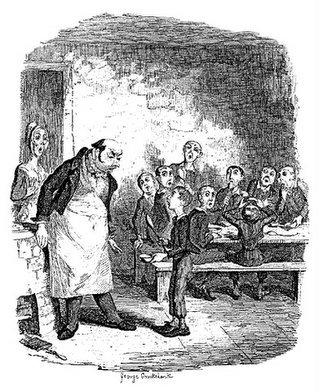
I Keep Thinking about that Oliver Twist Moment

We encounter young Oliver as a rebel in the scene pictured below, when the little orphan approaches the master of the kitchen on behalf of his schoolmate to ask for more.

here's the scene as Dickens wrote it:

Boys have generally excellent appetites. Oliver Twist and his companions suffered the tortures of slow starvation for three months: at last they got so voracious and wild with hunger, that one boy, who was tall for his age, and hadn't been used to that sort of thing (for his father had kept a small cookshop), hinted darkly to his companions, that unless he had another basin of gruel (r)per diem,� he was afraid he might some night happen to eat the boy who slept next him, who happened to be a weakly youth of tender age. He had a wild, hungry eye; and they implicitly believed him. A council was held; lots were cast who should walk up to the master after supper that evening, and ask for more; and it fell to Oliver Twist.

The evening arrived; the boys took their places. The master, in his cook's uniform, stationed himself at the copper; his pauper assistants ranged themselves behind him; the gruel was served out; and a long grace was said over the short commons. The gruel disappeared; the boys whispered each other, and winked at Oliver; while his next neighbours nudged him. Child as he was, he was desperate with hunger, and reckless with misery. He rose from the table; and advancing to the master, basin and spoon in hand, said: somewhat alarmed at his own temerity:

"Please, sir, I want some more."

The master was a fat, healthy man; but he turned very pale. He gazed in stupefied astonishment on the small rebel for some seconds, and then clung for support to the copper. The assistants were paralysed with wonder; the boys with fear.

"What!" said the master at length, in a faint voice.

"Please, sir," replied Oliver, "I want some more."

The master aimed a blow at Oliver's head with the ladle; pinioned him in his arms; and shrieked aloud for the beadle.

The board were sitting in solemn conclave, when Mr. Bumble rushed into the room in great excitement, and addressing the gentleman in the high chair, said,

"Mr. Limbkins, I beg your pardon, sir! Oliver Twist has asked for more!"

There was a general start. Horror was depicted on every countenance.

"For (r)more!�" said Mr. Limbkins. "Compose yourself, Bumble, and answer me distinctly. Do I understand that he asked for more, after he had eaten the supper allotted by the dietary?"

"He did, sir," replied Bumble.

"That boy will be hung," said the gentleman in the white waistcoat. "I know that boy will be hung."


(go here to see an entire edition of the book online. It has a somewhat odd introduction by that troublesome and yet fascinating conservative Catholic British author, GK Chesterton.)

The episode speaks to me so as a parallel with the public reaction to the transit workers strike, and now no-vote, because of the rage that greets the request for "more" when it comes from a union member. "WHAT?!" The headlines of the papers seemed to scream, "THEY WANT MORE?!" Surely, "they will be hung," has been close to the conclusion that the press has drawn. It seems that no amount is too small to be "enough" and no request for "more" is small enough to be acceptable. "What?!- You want a decent pension with health benefits after you retire?"
"What?! You want bathroom breaks?"
Of course the Transit workers are not timidly begging for more and they are not recipients of even mean charity as Oliver was, but the moralistic horror of the bourgeoisie at the mere demand for MORE from the working class is, if anything, more dramatic in New York City over the transit workers and other union members' demands than in Dickens' most famous scene of the stereotypically myopic bourgeoisie.
Despite the horror! of the city's well heeled at the thought of another bout of conflict with the TWU local 100's workers....I think the workers are placing their faith in the support they hope for from the rest of the city's population. I promise a more substantial update tomorrow.

Thursday, January 26, 2006

 
 Posted by Picasa

Draconian Punishment For GSOC Members at NYU - Don't Forget to Drop Some Dollars in the Hardship Fund Cup!

As the TWU's contract is back on the table, Grad students at NYU are still on strike. Back in December, when I went out on the TWU picket line, I met a striking NYU student whose Dad was a transit worker. With two strikers in the family, she knew both the high stakes and the hardship that come from the last resort that is the strike.
Lest we forget that this strike is on - book delivery men are honoring picket lines, which means that books were piling up outside the bookstore - the NYU administration has upped the stakes and cut off funding from some of the striking grad students in retaliation for their participation in the strike. This has only made NYU grad students and their supporters more determined. The activists at NYU are having meetings, organizing public events, rallies and a major strike-support fundraising drive as the Spring semester begins.If you have money to spare, it would help the grad students if you donated to the hardship fund.
Although this climate is tough for unions, I can't imagine that this move will do anything except win sympathy for the grad students. As "nerds on strike" (linked above) notes, several important institutions, including the Flaherty International Film Seminar, - and even the head of GHI's HMO, are now refusing to participate in events at NYU.
But, as usual, despite the word that "New York Is a Union Town" there are plenty of people who selfishly attack workers for demanding MORE from their bosses. I read a few popular blogs about NYC and I see a people still complaining about "how good the transit workers" have it and how inconvenient the strike was. I see NYU undergrads (only a few) writing letters to the NYU paper about how "selfish" the grad students living on poverty wagse at NYU are to ask for MORE.
What is this, Oliver Twist?
I wonder if this bullshit arbitration call from the MTA, which will surely be bad for workers if it goes through, and this even more harsh punishment for NYU's grad students represents more than a typical management response to a labor upsurge. I think that public support for the strikers is essential, and that we may all be called upon to get out in big numbers not just for the striking grad students, but for our hard-working transit workers.

Wednesday, January 25, 2006

One More Year of Our Lives Sucked Up in the Machine

I'm sitting exhausted in front of my computer, about to get back to work after a second long day of bullshit work "advising" students on what classes to take at the large urban community college that's already latched on to suck my blood for another semester, and I had this intense craving to hear Billy Bragg's song, "Must I Paint you a Picture?," which turns out to be on one of those albums not in my collection. ("Workers' Playtime") When searching for it, I realized that not only did I not have it, but that I only had "Talking with the Taxman about Poetry" on vinyl. I must have become so familiar with this song because of college radio, the juke box at the CC club, and that one live show. yeah, don't worry, I found a copy and am listening to it in a dreamy haze right now.

Just for the sake of nostalgia, here are the lyrics for you too....

It's bad timing and me
We find a lot of things out this way
And there's you
A little black cloud in a dress
The temptation
To take the precious things we have apart
To see how they work
Must be resisted for they never fit together again
If this is rain let it fall on me and drown me
If these are tears let them fall

Chorus:
Must I paint you a picture
About the way that I feel
You know my love for you is strong, girl
You know my love for you is real

It took a short walk and a talk
To change the rules of engagement
While you searched frantically for reverse
and then claiming
That virtue never tested is no virtue at all
And so I lost my ignorance

And now the bells across the river chime out your name
I look across to them again
(chorus)

All your friends said come down
It will never fly
And on that imperfect day
We threw it all away
Crisis after crisis, with such intensity
This would never happen if we lived by the sea

Most important decisions in life
Are made between two people in bed
I found that out at my expense
And when I see you
You just turn around and walk away like we never met
Oh we used to be so brave
I dreamt the world stopped turning as we climbed the hill
I dreamt impossible dreams that we were lovers still

It would make great karaoke, though I think this is one of those great melodies whose lyrics on their own seem a little adolescent. My best my memory of hearing it is from when I saw Billy Bragg w/ the Blokes at Irving Plaza at some point in the late nineties - around the time of the Clinton impeachment, because he was cracking jokes about Monica Lewinsky's dress. ("If the president wacked off on my dress, I'd save it too!") We probably marched around Macys that week shouting, "No War for Ramadan! and No War for Monica!" After the show, my friend Laura, often a model of uprightness, went wobbling and singing, "Must I Paint You a Picture??" in a bad cockney accent all the way to the Bleecker St. 6 station. That night, my friend Erin was also there with her then boyfriend, Bob, the fireman, who later died in the World Trade Center on Sept. 11th. Of course, today's ultra-patriotic right wing, who have claimed that tragedy for themselves, would never have imagined that any of NY's bravest were fans of a pinko-commie song writer.
Little did any of us know what was in store for us and the world in a few short years.
And with that, I'm returning to the 17th century.

Tuesday, January 24, 2006

Big News?

I haven't felt too much like blogging lately for some reason, but I'm back and to bad news. Alito just won his judiciary committee vote - with ten republican yes votes and eight Democratic party no votes. At least some of those dems. responded to the pressure from their constituents.
Speaking of congress, I did just see an interesting diary on the Daily Kos this afternoon, which reprints a story from the Conservative Washington Times that predicts impeachment proceedings to begin against Bush in the House by as early as next month. I find this doubtful. Kossacks have commented. I wonder what the folks at Capitol Hill Blue will have to say about this one. Nothing about impeachment there that I could see, but give them some time and I'm sure they'll say something.
Also today, I picked up and perused Doug Henwood's new book on the so-called "New Economy" and the current economic decline. I'm ambivalent about Henwood, who misprepresents anti-globalization activists, in my opinion, but more about this later.

Friday, January 20, 2006

Holy "No" Vote!

I knew those guys on the picket line looked pissed when I talked to them minutes after the press conference in which the end of the strike was announced. All of them wanted to know, "Why did we go out?" - if the result was going to be this bad, and now they've voted.
Clearly, this wasn't Toussaint's doing. I don't have enough time to write a lot about this now, but my main comment is that the TWU's workers have surprised everyone in this city. People I knew said "they won't go out," and then a lot of local labor pundits were saying the strike was a victory. Others have pointed out that the give-back on health-care was a net loss. It seems in the end that the workers weren't satisfied with the direction the leadership took.
I don't pretend to know what this ultimately means, but it does send a message that I'm glad to see: First, this "no" vote should convince people that the members of unions don't just take orders from the "union bosses" and it should also convince at least a few union leaders that the leadership is not always "out in front" of a passive membership.

The Right Gets Right Down To Work

I was just checking "Raw Story" this morning and found an article from the Cincinnati Enquirer about a May bill being revived in the Ohio State legislature to make abortion a crime. I can't imagine that this will pass. Probably the most relevant section defines person as follows:
(B)(1)(a) Subject to division (B)(2) of this section, as used in any section contained in Title XXIX of the Revised Code that sets forth a criminal offense, "person" includes all of the following:

(i) An individual, corporation, business trust, estate, trust, partnership, and association;

(ii) An unborn human who is viable.

(b) As used in any section contained in Title XXIX of the Revised Code that does not set forth a criminal offense, "person" includes an individual, corporation, business trust, estate, trust, partnership, and association.

(c) As used in division (B)(1)(a) of this section:

(i) "Unborn human" means an individual organism of the species Homo sapiens from fertilization until live birth.

(ii) "Viable" means the stage of development of a human fetus at which there is a realistic possibility of maintaining and nourishing of a life outside the womb with or without temporary artificial life-sustaining support.

(2) Notwithstanding division (B)(1)(a) of this section, in no case shall the portion of the definition of the term "person" that is set forth in division (B)(1)(a)(ii) of this section be applied or construed in any section contained in Title XXIX of the Revised Code that sets forth a criminal offense in any of the following manners:


This construal of abortion as the killing of a "person" would produce an abortion law much more restrictive than any laws prior to Roe v. Wade because it does not acknowledge even what is commonly referred to as "therapeutic abortion."
Given the generally "way-the-hell-out-there" character of ultra-conservative Ohio legislator, Tom Brinkman, who has also made news by setting out to challenge to Jean Schmidt for her US congressional seat, it seems unlikely to me that this bill will pass.

Wednesday, January 18, 2006

Another Smoking Gun

Last night, a friend told me about the several days worth of hoopla dedicated to the exaggerations of James Frey in "A Million Little Pieces." "It took up the whole Week In Review!" he exclaimed.
Readers were just outraged that they'd been betrayed and now they are suing Mr. Frey for lying to them.
Meanwhile, in the NYT today, there's an article about yet another smoking gun" memo that has been unearthed about what the Bush administration refer to as "faulty intelligence" and what the rest of us call "cooking up a phony threat of nuclear weapons in Iraq to scare the public into a war in Iraq." Raw Story today has an article about the connection of Michael Ledeen to the forged Niger documents. "Surprisingly," this news, which suggests that despite their claims to be simply "ill informed," the Bush administration knew those docs. were fake before they used them as a reason to go to war, is not all over the front pages of American newspapers.

Monday, January 16, 2006

On Rev. Dr. Martin Luther King Jr's Birthday, Think About How Far Back We've Slid

I don't mean to interrupt all the cheery talk about racial progress(As one of my favorite people once said in a discussion about whites' beliefs about their own racial attitudes, every few years, a study comes out that says, "whites: getting better all the time.") since the years of the Civil Rights Movement, but I have just been reading Jonathan Kozol's new book, "Shame of the Nation." The world Kozol describes in his book fits my experience pretty well. So-called "diverse" schools are often 90%+ African-American and hispanic. And surprise, surprise, the separate schools are unequal. Testing has twisted the meaning of education and the last twenty-five years of economic policies have hurt America's cities, making people's lives chaotic.
So, sorry I'm in a crabby mood, but it looks like that Alito is going to slide right onto the Supreme Court, and this terrible illegal waris still going on. And as a reflection of the larger policy problems, there are those widespread racist attitudes that people still exhibit. For example, we learned this year that it's still "hip" and "edgy" in some "alternative" social scenes to be a racist asshole.
However, I do go teach every day in a "diverse" school (ie, 85% "minority" according to one website) and it does feel like the post-civil rights era when I'm with them.... sort of.

yeah, yeah, yeah, let's all get to work.

Saturday, January 14, 2006

A Different Roe v. Wade Parallel to Scott v. Sandford

So, as you might have guessed from my previous entry, I'm reading Peter Irons' book, A People's History of the Supreme Court. As many of you probably also know, because Bush referenced the argument during the debates in Oct. '04, lots of anti-abortion activists compare the Roe v. Wade decision to the Dred Scott decision. Their logic is simply that since 1973, foetuses are comparable to pre-1865 African-Americans, denied rights as a whole "class of people." Maybe I'd buy it, if foetuses were leading their own civil rights movement but, I think Terri Schiavo will rise from the grave before that happens. The important point about the Dred Scott/Roe v. Wade parallel on the right is that it shows how little the "right to life" movement cares about rights in general.
At least, they're not interested in the kind of rights that Dred Scott and other African-Americans were fighting for in the 19th century. Unlike adult African-Americans, and every other class of people who have ever fought for their rights, foetuses (and even babies) really are different from adult humans. A foetus can't demand freedom, and would, in fact, die, if it tried to "live free."
A baby, once born into the world can be said to have a right to be cared for, as a dependent who would die without care, but that's about the only right it has. It doesn't have the right to vote, to decide what to eat, to choose which kinds of diapers to wear, when to go to bed, or where to live, because it's not capable of making such decisions, or even articulating its wishes for these things. In fact, laws hold adults responsible for the lives of these dependents and do not hold the infants responsible for their own decisions.
The legal (and "natural") responsibilities of the parent towards a child are what makes it so important that parenthood be chosen by the parent and not forced upon him or her. After all, it's not the foetuses who are choosing to be born when women are denied these decisions, it's the state that's choosing life for these future babies. We can all say that people have a right to make their own decisions about whether or not to take on major responsibilities, and we'd all say that people must care for the helpless dependents that they've brought into the world, but I doubt that many people, if they thought about it in these terms, would really argue that a foetus has an inherent right to be born. After all, one of the first things that an angry kid will tell a parent acknowledges the child's lack of choice in the whole matter, "I didn't ASK to be born!"
Now it's easy to see how strange it is to parallel the adult Dred Scott to a foetus using the language of "rights." Since the right that Dred Scott was fighting for was not "life," but "freedom," and since children, (and not foetuses) are the only class of dependents capable of demanding rights, the logical extension of the Christian right's comparison of foetuses to Dred Scott would be to see the whole crowd become champions of children's freedom from the confines of parental authority. Unfortunately for them, this would be inconsistant with the rest of their philosophy of the family as a patriarchal hierarchy. Again, the Dred Scott parallel fails. For, the fight for civil rights did not even end with the right to be free, but continued with a demand for political equality.
For this reason, we miss the point when we criticize the right for hypocrisy when we point out their lack of interest in the welfare of born children. The most important problem with the right-wing argument about the "rights of the unborn" is that the movement implies that it is protecting one group's rights against another group's rights, when in fact, it has nothing to do with rights at all.
....So I do see a tiny parallel to the Dred Scott case to the abortion issue. Dred Scott's case involved being taken by a Southern slave-holder into a free state where slavery was illegal. Under the laws of that state, Scott sued for his freedom. Under one law he was free, having been emancipated by the move, but he eventually lost at the Supreme Court, where the court ruled he didn't even have a right to sue.
The situation of different states with different laws regarding slavery and African-American rights and the eventual resolution of this problem in a Supreme Court case does seem slightly parallel to the situation in the US with abortion today. Certain states have such intense restrictions on abortions that women are unable to get abortions where they live and must travel out of state, seeking a "free" state. In both cases there is a controversy about basic rights in the country that resulted in a patchwork of states with different laws and an attempt to resolve the contradictions in the Supreme Court. Roe V. Wade was initially the case that nationalized the right to a legal abortion, and the goal of conservatives in state legislatures, congress, and the Supreme court is to get rid of this right, until the states where women have a right to a safe abortion are the rarity. So it seems the bigger parallel would be be if Alito's dissent in Casey had been the majority opinion. Now THAT would have been a Dred Scott case.

Friday, January 13, 2006

Time Machine Snippet...

In the few minutes of work I did today, I came across this quotation from Peter Irons about John Marshall:
Marshall was plain and humble in person, yet he was an aristocrat in outlook. He came from a state that vigorously insisted on its sovereign rights within the Union, but he favored a general government in almost every case he decided. He read the Constitution broadly to protect the rights of property, but narrowly when he addressed individual rights.


(yeah, I JUST found that block-quote key on my editing screen. oy, now I'm really embarassed about all those italicized quotations.)

Do you think that maybe one could say the same thing about Judge Alito, who seems so humble and kind ot his peers, but so cruel and indifferent to the people who are affected by his decisions?

Thanks for the Blog Recs.

Thank you everyone who posted blog recs. Here's the crop: Legal Blog watch which links to several other recommended blogs, including Firedoglake, Black Prof, and the live SCOTUS blog.
Today, I was totally disgusted first by the American Bar Association, and then by the Federal Judge praise-fest for Alito. I had high hopes for the witnesses who were going to appear later in the day, but was somewhat disappointed with the anti-Alito crowd, whose very good arguments were drowned in a sea of right-wing blather.
Because the Repubs. want to come off as folksy, it's easy for them to dismiss the arguments of anyone who makes an even remotely sophisticated argument, such as the one by Liu, and then Senator Kennedy that most judges agree 90% of the time, and that the critics were focusing on the other 10% because those are the ones that are significant in revealing "judicial philosophy." The Repubs just wagged their heads and call it "cherry picking." Thus it was hard to expose the man for the right-winger that he is.
For me, the worst part of today's hearing was finally hearing exactly what Alito himself had to say, as his dissents and memos were discussed by Goodwin Liu, and by hearing those views defended in the Senate. For example, when confronted with Alito's 1984 memo in which he justified the shooting by police of an 8th grader who was unarmed and fleeing, Sen. Sessions in particular made the case for the "rights" of the police to do their job effectively, or words to that effect. The "greater interest" in the case of the kid getting shot was to keep allowing the cops to "protect US." How is it that people can say these things without alarm bells ringing for people? Who, exactly, does Sessions think is "US"anyway ?
The Republicans, on the other hand, had succeeded well in portraying the hearings themselves as just kinda silly and pointless, mean even. This seems especially true now that the corporate media coverage is focusing exclusively on the fact that Mrs. Alito cried during the hearing.
Speaking of crying...following my day of SCOTUS obsession, I watched the second episode of Frontline's Country Boys with my room-mate. When 17 year-old Chris's mom ditched him with his alcoholic Dad and little sister to take care of, the school principle told him she might be able to give him some help with "time management" work to help balance his full-time job, home life, and school work, but that he could do it: "you have responsibilities, but I think you're ready for them," I was reminded of George Bush's ridiculous press conference comment to that woman with three jobs, "uniquely American!"
After listening to that wanker, Lindsey Graham and watching that show in all one day, the insanity of our society's belief that individual character is the source of all things, whether or good or bad, was just about as starkly clear to me as it's going to get. Unfortunately, the more that I listen to these absurdities, the more crazy I begin to feel. aiee.

Wednesday, January 11, 2006

Everyone Should Watch "Country Boys" on Frontline

I've been just watching and listening all day. I don't know how I became so passive, but I wasn't working. I listened to the Alito hearings all afternoon, ran errands listening to a book on tape, then finally started watching that new Frontline Documentary, Country Boys, which is airing on PBS this week, and can be watched in its entirety online. It really is well-done and thought provoking. The folks over at Southern Exposure like it too. The documentary depicts Appalachian culture and rural poverty in a way that maintains the dignity of the subjects. It is also a window, perhaps, into what some might refer to as "red state America" where people who are hurt by current administration policies are nonetheless deeply conservative, at least that's how it seems after watching the first hour.

I must say that while I am completely engaged by both the boys, I am not as wild about the "David School," as many viewers seem to be, judging from viewers' comments in Frontline's discussion forum. It is an alternative high school with a religious foundation and a deep dedication to its students. During the documentary, you see one of the boys, Chris, get a huge amount of support in his effort to start a school newspaper. you also see Cody, the more emotionally disturbed boy, have a very empathic disciplinary meeting with the principal following a conflict with his history teacher. This is all to the good.
Rarely do students get this kind of personal attention in any setting, and the small scale and dedication at the David School for this reason are invaluable. At the same time, can we not also demand that for students like Chris and Cody that they have a science teacher who's willing to teach evolution and doesn't dismiss the whole discussion of reproductive technology and cloning with the comment, "don't mess with God's creation?" Other classes depicted in the documentary were less alarming, but I think this kind of miseducation is just a crime, and I was surprised to see no one mentioned it on the Frontline forum.
While it is important to support and help students, it would help if the teachers were qualified to teach the subject matter in addition to being a group of supportive people who acted as a second family. It is probably because the second thing is such a bigger and more difficult task, and has such immediate and direct results in the lives of individuals that it gets all the attention, but I wonder what Chris and Cody will know - about science, history, and all those "school" things when they graduate. I recognize that there is more to education than "book learning," and that "book learning" was probably promoted too much in my family for me to have a balanced perspective on the issue, but it troubles me that academic challenges seemed to disappear all together at the David School, and that the material discussed in the classes was often simplistic or just wrong. Would many of the middle-class viewers who praised the school teachers as heroes for doing the hard work of being nice to Cody and Chris be happy to send their own "best and bright" teenagers there? Should Cody, who likes to cite various statistics and facts in his classes ever find a teacher that will challenge him to defend his ideas and facts more fully or to discuss their meanings in greater depth? Cody, who sings in a Christian heavy metal band, at one point tells his friends that the "government" owns about 30% of the US land, (I checked this and it turns out to be about 21% if you include the national parks) and he follows that with some not-so-well-thought-out anti-government comments. When he made a similar comment in class about the new attempts to make it possible for men to give birth, the teacher had never heard of what he was talking about and couldn't engage in a meaningful discussion of it. Wouldn't it be nice if the teachers in the school were qualified to actually discuss these issues with students instead of just talking about God ,teaching them to respect other people, and come to class on time? What does it tell students when their teachers are so unable to respond to their intellectual curiosity or to take up their challenges? I'm sure it left a confrontational and restless kid like Cody bored and ready for 1/2 baked theories.
I'll have to wait to see the rest of the series, but I'm guessing that Cody's provocative questions will not be embraced as part of his maturation process, and i think that would be a pity. It's essential to repsond to emotional needs, but a school that fails to respond to intellectual needs is ultimately bad for us all politically. So far, what I saw in "Country Boys" doesn't make me feel hopeful in the long run.

Favorite Blogs on the Alito Hearings

So, I know some of you really follow law blogs, and some of you are religious readers of Dkos, and some are readers of more obscure left wing websites. I'm asking a favor from you now. Please recommend your favorite blogs for reading about the Supreme Court and the Alito hearings.
I'll start it out by saying I like to check out Jack Balkin's blog now and then.

Moments of Absurdity from the Alito Hearings: Open Thread

It's been a week of lazy blog entries, and I'm sorry, but I have to continue the trend. Please pony up with your favorite absurdity from the Alito hearings. For the disingenuous award yesterday, I'd have to go with Alito's statement that he had "no opinion" on Bush v. Gore because he hadn't studied it.

My other favorite aspect of the hearing is the window into right-wing ideology on abortion, such as the implied comparisons of Roe v. Wade with Plessy v. Fergusen that keep coming up when Repubs. do the questioning.

And yours?

Monday, January 09, 2006

Who Was the Biggest Wingnut? Vote Here!

If you watched or listened to today's hearings of Samuel Alito, who would you pick as the biggest wingnut of the day? I'd go for the last one, who I think was the last Republican, Tom Coburn of Oklahoma. He listed several recent Supreme Court decisions that he found to be contradictory and then said they were "schizophrenic," and why so schizophrenic? he explained, because they're "without foundation."
I guess he thinks the only foundation worthy of mention would be the Old Testament, huh? Because the foundation I think that might explain some of the conflicting decisions he listed would be the US Constitution.

Pet Peeves: Open Thread

I was reading the NY Times editorial page today and found Stanley Fish's "questions" for Judge Alito's confirmation hearings and had a moment of peevishness. Perhaps it can be pardoned on the NYT editorial page, and Fish's explanations of the decisions he's citing are helpful to the uninformed reader, but the length of these questions reminded me of just how much I hate it when people use the opportunity to ask a question as an opportunity to show off. Better examples than Stanley Fish's questions in today's NYT can be found at the average academic lecture, where professors will typically ask a "question" beginning with, "What you say is very interesting, because I'm working on...."
rrggh.
Any pet peeves out there?

Saturday, January 07, 2006

Mine Disaster News

This will be a brief entry, because my ten year old monitor cuts off every few minutes now. Until the new one arrives, I'll be forced into pithiness.

Yesterday, I was in the gym and one of those ubiqitous televisions featured an interview with the surviving miner's wife. The interviewers kept asking, "why do you think your husband survived? What was it in his personality that kept him struggling?"
Now, I understand that the people who know this particular man might want to attribute his survival to his inner strength, but I'm sure that the wives and friends of the men who died wouldn't think so. Why were they asking his wife this, anyway? Shouldn't they have had the mine owners and engineers and regulators on to talk about what happened? They are the ones investigating, according to the New York Times,

What caused the explosion, which apparently occurred in a sealed, abandoned part of the mine? What led to the miscommunication that caused the miners' families to believe for three hours that the men had been rescued? Why was one miner, Randal McCloy Jr., able to survive?

Reading about Mr. McCloy sitting there while his friends died just gives me the shivers, and while there are complicated scientific answers to these questions, I'd say the answer to the question of why those men died was simply, "capitalism," or, if you're more liberal social-democratic than socialist, you can call it, "robber baron unregulated capitalism" if you want. Those men died because their lives were cheap to the men who owned the mine. And the men who owned the mine control the regulators. Isn't that the way it always is?
Here's a song by Hazel Dickens about the 1968 disaster in the Mannington Mine, also in West Virginia, which had also received citations for safety violations before the explosion of the mine killed seventy-eight men.:
We read in the paper and the radio tells
Us to to raise our children to be miners as well.
Oh tell them how safe the mines are today
And to be like your daddy, bring home a big pay.

Now don't you believe them, my boy,
That story's a lie.
Remember the disaster at the Mannington mine
Where seventy-eight miners were buried alive,
Because of unsafe conditions your daddy died.

They lure us with money, it sure is a sight.
When you may never live to see the daylight
With your name among the big headlines
Like that awful disaster at the Mannington mine.

So don't you believe them, my boy,
That story's a lie.
Remember the disaster at the Mannington mine
Where seventy-eight miners were buried alive,
Because of unsafe conditions your daddy died.

There's a man in a big house way up on the hill
Far, far from the shacks where the poor miners live.
He's got plenty of money, Lord, everything's fine
And he has forgotten the Mannington mine.
Yes, he has forgotten the Mannington mine.

There is a grave way down in the Mannington mine
There is a grave way down in the Mannington mine.
Oh, what were their last thoughts, what were their cries
As the flames overtook them in the Mannington mine.

So don't you believe them, my boy,
That story's a lie.
Remember the disaster at the Mannington mine
Where seventy-eight good men so uselessly died
Oh, don't follow your daddy to the Mannington mine.

How can God forgive you, you do know what you've done.
You've killed my husband, now you want my son.


(You can hear the song on the record "Coal Mining Women," which I have just found available on itunes. )
That disaster led to massive miner protest and the passage of the Black Lung bill in 1969. More later.

Wednesday, January 04, 2006

Bringing the Business to the White Liberals, Once Again - First Dylan Now McGruder

Please pardon extensive quotations for this entry, but I just had to point out these hilarious events. As a prelude, let me first say that I hate Eric Alterman and his strategy of bringing the white man to the center of all things "left" as often as he can (see, for example, his debate with Robin DG Kelley from "The Nation" in May of 1998, and his more recent idiotic argument about Roe v.Wade during the Roberts' confirmation hearings).
That's why I got such a kick out of this New Yorker article that a friend forwarded to me this morning. It includes the description of a Nation awards dinner at which Aaron McGruder spoke:

Toward the dessert (chocolate torte) portion of the evening, Uma Thurman rose to introduce a special guest: Aaron McGruder, the creator of the popular and subversive comic strip “The Boondocks,” who, as it happens, had travelled farther than anyone else to be there, all the way from Los Angeles. McGruder, one of only a few prominent African-American cartoonists, had been making waves in all the right ways, poking conspicuous fun at Trent Lott, the N.R.A., the war effort. An exhibition of his comic strips—characters with Afros and dreadlocks drawn in a style borrowing heavily from Japanese manga,with accentuatedforeheads and eyes—was on display in the Metropolitan Club’s Great Hall. It seemed to be, as a Nation contributor said later, “his coronation as our kind of guy.”
But what McGruder saw when he looked around at his approving audience was this: a lot of old, white faces. What followed was not quite a coronation. McGruder, who rarely prepares notes or speeches for events like this, began by thanking Thurman, “the most ass-kicking woman in America.” Then he lowered the boom. He was a twenty-nine-year-old black man, he said, who got invited to such functions all the time, so you could imagine how bored he was. He proceeded to ramble, at considerable length, and in a tone, as one listener put it, of “militant cynicism,” with a recurring theme: that the folks in the room (“courageous”? Please) were a sorry lot.
He told the guests that he’d called Condoleezza Rice, the national-security adviser, a mass murderer to her face; what had they ever done? (The Rice exchange occurred in 2002, at the N.A.A.C.P. Image Awards, where McGruder was given the Chairman’s Award; Rice requested that he write her into his strip.) He recounted a lunch meeting with Fidel Castro. (He had been invited to Cuba by the California congresswoman Barbara Lee, who is one of the few politicians McGruder has praised in “The Boondocks.”) He said that noble failure was not acceptable. But the last straw came when he “dropped the N-word,” as one amused observer recalled. He said—bragged, even—that he’d voted for Nader in 2000. At that point, according to Hamilton Fish, the host of the party, “it got interactive.”
Eric Alterman, a columnist for The Nation, was sitting in the back of the room, next to Joe Wilson, the Ambassador. He shouted out, “Thanks for Bush!” Exactly what happened next is unclear. Alterman recalls that McGruder responded by grabbing his crotch and saying, “Try these nuts.” Jack Newfield, the longtime Village Voice writer, says that McGruder simply dared Alterman to remove him from the podium. When asked about this incident later, McGruder said, “I ain’t no punk. I ain’t gonna let someone shout and not go back at him.”
Alterman walked out. “I turned to Joe and said, ‘I can’t listen to this crap anymore,’ ” he remembers. “I went out into the Metropolitan Club lobby—it’s a nice lobby—and I worked on my manuscript.”
Newfield joined in the heckling, as did Stephen Cohen, a historian and the husband of Katrina vanden Heuvel. “It was like watching LeRoi Jones try to Mau-Mau a guilty white liberal in the sixties,” Newfield says. “It was out of a time warp. Who is he to insult people who have been putting their careers and lives on the line for equal rights since before he was born?”
By the time McGruder had finished, and a tipsy Joe Wilson took the microphone to deliver his New Year’s Resolutions, perhaps half the guests had excused themselves to join Alterman in the lobby. A Nation contributor estimated that McGruder had offended eighty per cent of the audience. “Some people still haven’t recovered,” he said, sounding thrilled.
“At a certain point, I just got the uncomfortable feeling that this was a bunch of people who were feeling a little too good about themselves,” McGruder said afterward. “These are the big, rich white leftists who are going to carry the fight to George Bush, and the best they can do is blame Nader?”
He went on, laughing a little, “I was not the right guest for that event. I’ll be the first one to say that. It was one of those reminders that, yeah, I’m not this political leader that people are looking for.”


All right, now wind back your time-machine for a similar backfiring and hilarious speaker at the Tom Paine awards in 1963. At this event, Bob Dylan, among other things,
got up and said,

I'm proud that I'm young. And I only wish that all you people who are sitting out here today or tonight weren't here and I could see all kinds of faces with hair on their head - and everything like that, everything leading to youngness, celebrating the anniversary when we overthrew the House Un-American Activities just yesterday, - Because you people should be at the beach. You should be out there and you should be swimming and you should be just relaxing in the time you have to relax. (Laughter) It is not an old peoples' world. It is not an old peoples' world. It has nothing to do with old people. Old people when their hair grows out, they should go out. (Laughter) And I look down to see the people that are governing me and making my rules - and they haven't got any hair on their head - I get very uptight about it. (Laughter).....So, I accept this reward - not reward, (Laughter) award in behalf of Phillip Luce who led the group to Cuba which all people should go down to Cuba. I don't see why anybody can't go to Cuba. I don't see what's going to hurt by going any place. I don't know what's going to hurt anybody's eyes to see anything... I'll stand up and to get uncompromisable about it, which I have to be to be honest, I just got to be, as I got to admit that the man who shot President Kennedy, Lee Oswald, I don't know exactly where --what he thought he was doing, but I got to admit honestly that I too - I saw some of myself in him. I don't think it would have gone - I don't think it could go that far. But I got to stand up and say I saw things that he felt, in me - not to go that far and shoot. (Boos and hisses) You can boo but booing's got nothing to do with it. It's a - I just a - I've got to tell you, man, it's Bill of Rights is free speech and I just want to admit that I accept this Tom Paine Award in behalf of James Forman of the Students Non-Violent Coordinating Committee and on behalf of the people who went to Cuba. (Boos and Applause)


While Dylan and MacGruder had different gripes about their audiences, for MacGruder race is the issue, for Dylan, it seemed to be age and style, they both managed to freak out complacent liberals who wanted to coopt them for their own reasons. And what's not to enjoy about that?

How Could They Have Been Alive?

I woke up to the news this morning that papers everywhere had printed that the miners in Sago, West Va. had survived the mine cave-in, despite earlier reports that the test of the air in the mine revealed that it contained almost four times the carbon monoxide that is safe to breathe. While the story of this false news bulletin reveals yet again the bad reporting skills of America's mainstream media, I still think that the issue we should be talking about is the failure of the MSHA and its connection to deregulation in general.
As the UMWA has pointed out previously, Bush appointees such as Davd G. Dye and Elaine Chao, seem to be ready to heavily regulate mine workers, who they want to test for drugs after mine accidents, rather than mine owners, who in this case, according to James Ridgeway, paid just about $24,000.00 in fines for their 200 violations of mine safety laws over the last two years.
"Confined Space" author Jonathan Barab is also writing about the disaster and notes,

The fact is that President Bush has not requested budgets for OSHA or MSHA that even keep up with the rate of inflation and mandatory pay increases over the past several years while penalties for OSHA or MSHA violations remain laughably low. The highest penalty of the more than 200 citations received last year by the Sago mine was $878. But that was the exception. Most of the others were $250 or $60. At that rate, it's hardly a good business decision to even bother fixing anything. And the administration has shut down any new worker protection standards in OSHA and MSHA.

Ridgeway also points out the ages of many of the now deceased miners, the oldest of whom was 61, and several of whom were over fifty years old. After all the pooh-poohing of the retirement age for transit work in NYC during the recent TWU strike, the ages of these men should ring some kind of bell. Why not let miners and others in dangerous work retire earlier than others, especially since these kinds of jobs often leave people with health problems that substantially reduce their life-spans?
Will the chant of the New Year be, "Jail to the Palace, Pensions to the Cottage, and Campouts in front of the homes of luxurious idleness?" and if so, is that the best that can be hoped for?

Tuesday, January 03, 2006

The Invisibility of Workplace Death and Injury

In all the reporting of violence and crime that goes on in the US, there's rarely anything about the number of injuries and deaths of workers on the job. A big mine cave -in like the one in Sago, West Virginia is usually what it takes to bring this issue to the nation's attention. But even when the disasters are being publicized, the really pertinent news isn't always up front. For example, read the LAST paragraph in today's NYT article on the cave in:
According to the [mine safety and heath administration] agency, the Sago mine received 208 citations in 2005, up from 68 in 2004. Sixteen of those were for violations that the mine operators knew about but did not repair before inspectors caught them, the agency said. The company said those numbers were not out of the ordinary.
The Detroit Free Press includes more detailed information on the violations:

Federal inspectors cited the mine for 46 alleged violations of federal mine health and safety rules during an 11-week review that ended Dec. 22, according to records.
The more serious alleged violations, resulting in proposed penalties of at least $250 each, involved steps for safeguarding against roof falls and the mine's plan to control methane and breathable dust. The mine received 208 citations from the federal Mine Safety and Health Administration during 2005, up from 68 in 2004.
Also, the state's Office of Miners' Health Safety and Training issued 144 notices of violation against the mine in 2005, up from 74 in 2004.

The blog, "Confined Space" does a regular update on workplace deaths called "the weekly toll," and is keeping up to date on the trapped miners.
The CPUSA's paper has an article about Bush appointee to msha secretary David G. Dye's predecessor (David Lauriksi) headlined, "Bush policies threaten miners' health" from just over a year ago.
I'll try to find out more about the policies there later, but at the moment, I've gotta go.

Sunday, January 01, 2006

what the hell, a top ten list

Tell me your top ten most-listened to albums of the year (that means they don't have to be from 2005.)

Here are mine in no special order:

Separation Sunday, the Hold Steady
Almost Killed Me, The Hold Steady
Party Music, the Coup
Get Away From Me, Nellie McKay
Castaways and Cutouts, The Decemberists
Gravity, Alejandro Escovedo
No Other Love, Chuck Prophet
The Hurting Business, Chuck Prophet
Kling Klang, Tussle
1972, Josh Rouse
oh and I just can't leave out...

lots and lots of Bob Marley and
"Dub Fire" and "King Tubby's Dancehall Dub" by Sly and Robbie
and Gogol Bordello, "Multi Kontra Kulti"

Any votes for fresh tracks to listen to in 2006?
I'm starting my New Year's day with Theivery Corporation's Richest Man in Babylon.